

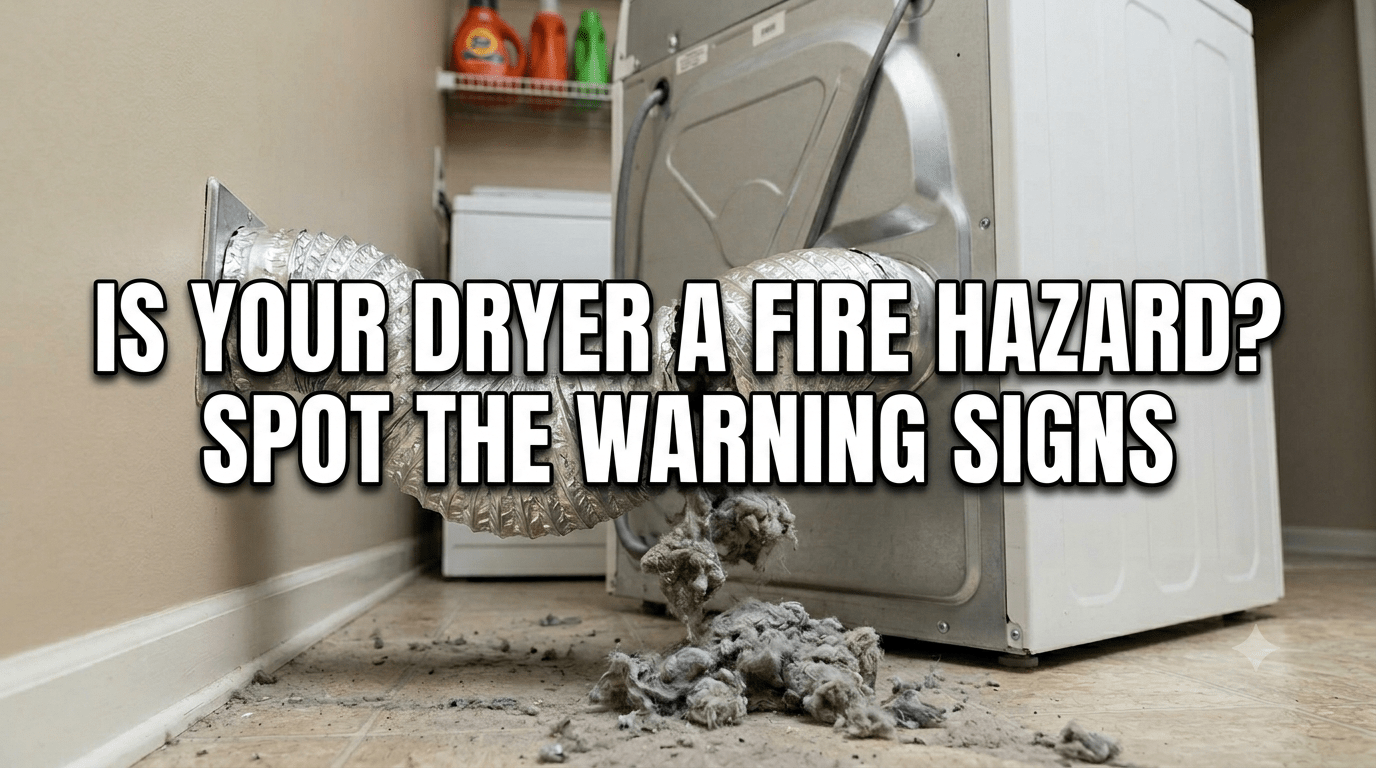
Signs of a clogged dryer vent are often completely ignored by homeowners until it is too late. We rely heavily on our household appliances to make our lives easier, and the clothes dryer is one of the hardest-working machines in any home. However, it is also statistically one of the most dangerous. According to the National Fire Protection Association (NFPA), failure to properly clean the dryer vent is the leading cause of residential dryer fires, resulting in thousands of home fires and millions of dollars in property damage every single year.
Many homeowners mistakenly believe that routinely emptying the small lint trap inside the dryer door is enough to keep the machine safe. In reality, that small screen only catches about 25% of the lint your clothes produce. The other 75% is composed of microscopic fabric fibers, pet hair, and dust that bypasses the screen and gets blasted directly into your exhaust hose. Over time, this damp, sticky lint coats the interior walls of your exhaust pipe, creating a highly flammable, impenetrable blockage.
At The Duct Pros, we are deeply committed to protecting your home from preventable disasters. A lint-clogged exhaust system does not just waste electricity; it creates a literal ticking time bomb in your laundry room. Here is a comprehensive guide to identifying the immediate warning signs of a severe blockage, the thermal mechanics of a dryer fire, and why professional extraction is the only safe solution.
1. Clothes Taking Multiple Cycles to Dry
This is the absolute most common, and most ignored, warning sign of a severe lint blockage. A standard load of laundry should be completely dry in 40 to 50 minutes.
The Moisture Trap: Your dryer works by heating the wet clothes and blowing the resulting moisture out of the exhaust vent to the exterior of your home. If the vent is clogged with lint, that heavy, humid air cannot escape.
The Saturated Drum: Because the moisture is trapped, it simply recirculates back into the dryer drum. Your clothes are essentially baking in a high-heat sauna rather than drying. If you find yourself having to run the same load of towels or heavy jeans two or three times to get them completely dry, your exhaust pipe is functionally sealed shut.
2. The Dryer is Extremely Hot to the Touch
A clothes dryer is designed to retain heat internally, not radiate it aggressively into the room.
Thermal Overload: When the hot exhaust air cannot vent outside, the thermal energy backs up into the machine itself. If the top or sides of your dryer are burning hot to the touch at the end of a cycle, the appliance is in a state of severe thermal overload.
Ruined Clothing and Sensors: This extreme backup of heat will not only fry the delicate internal sensors and heating elements of your expensive appliance, but it will also physically scorch your clothing, causing elastic to melt, colors to fade prematurely, and fabrics to shrink aggressively.
3. A Noticeable Burning Smell During the Cycle
If you ever smell smoke or a faint burning odor coming from your laundry room, you must immediately stop the machine and unplug it.
The Flash Point of Lint: Dryer lint is incredibly flammable. It is composed of dry cotton, polyester, and hair. When the exhaust vent is clogged, the extreme heat backing up into the machine can easily reach the flash point of the lint trapped in the heating element housing.
The Pre-Fire Warning: A burning smell means that small pockets of lint inside the machine or the transition hose are actively beginning to singe and smolder. This is the final physical warning sign before the smoldering lint fully ignites and the high-velocity blower motor fans the flames directly into your wall cavity.
4. The Exterior Vent Flap is Stuck Shut
The easiest way to check the health of your system is to step outside your house while the dryer is running.
The Airflow Test: Locate the exterior exhaust hood (usually located on the side of the house or up on the roof). When the dryer is operating, the plastic or metal louvers should be blown completely open by a strong, steady stream of hot air.
The Dead Vent: If the louvers are barely moving, or if they are completely stuck shut by a thick, protruding mat of gray lint, your system has zero airflow. The exhaust pipe is completely impacted, and the dryer is operating under highly dangerous static pressure.
5. Professional Extraction vs. The DIY Mistake
Hardware stores sell cheap, 10-foot nylon brush kits marketed to homeowners for DIY dryer vent cleaning. Using these kits is often a highly frustrating and dangerous mistake.
The Compaction Hazard: Most residential dryer vents run 20 to 40 feet through walls, ceilings, and 90-degree elbows before reaching the outside. A flimsy manual brush cannot navigate these tight turns. Instead of extracting the lint, the homeowner usually just pushes the blockage deeper into the wall, compacting it into a dense, solid brick of lint that completely kills the airflow.
Commercial Rotary Extraction: At The Duct Pros, we use specialized, highly flexible rotary cables powered by high-torque drills, combined with intense HEPA-filtered vacuum suction. We feed these tools from the exterior of your home all the way to the back of the dryer, safely breaking apart the most stubborn clogs and extracting 100% of the highly flammable debris.
Stop ignoring your struggling appliance and protect your family from a devastating house fire. Maximize your dryer’s efficiency and secure your home’s safety by scheduling a professional dryer vent cleanout today.
📞 (866) 712-1122 🌐 www.TheDuctPros.us 📧 Info@TheDuctPros.us
🎯 Frequently Asked Questions About Dryer Vent Safety
How often should a residential dryer vent be cleaned? Fire safety experts and appliance manufacturers universally recommend having your dryer vent professionally cleaned at least once every 12 months. However, if you have a large family, wash heavily soiled work clothes, own shedding pets, or have a vent line that exceeds 20 feet with multiple turns, you should schedule a cleaning every 6 to 8 months.
Will a clogged dryer vent increase my electric bill? Drastically. If your vent is clogged, a standard 45-minute drying cycle can turn into two or three 60-minute cycles just to dry one load of laundry. Clothes dryers are high-draw, 240-volt appliances. Forcing them to run two to three times longer than necessary will cause a massive, noticeable spike in your monthly utility bills.
Can a clogged vent permanently damage my clothes dryer? Yes. When a dryer cannot exhaust its heat, the internal temperature skyrockets. This thermal overload frequently causes the high-limit thermostat to blow, the thermal fuse to trip, and the main heating element to burn out completely. Professional cleaning can easily save you from a $800 to $1000 appliance replacement or expensive repair bill.