
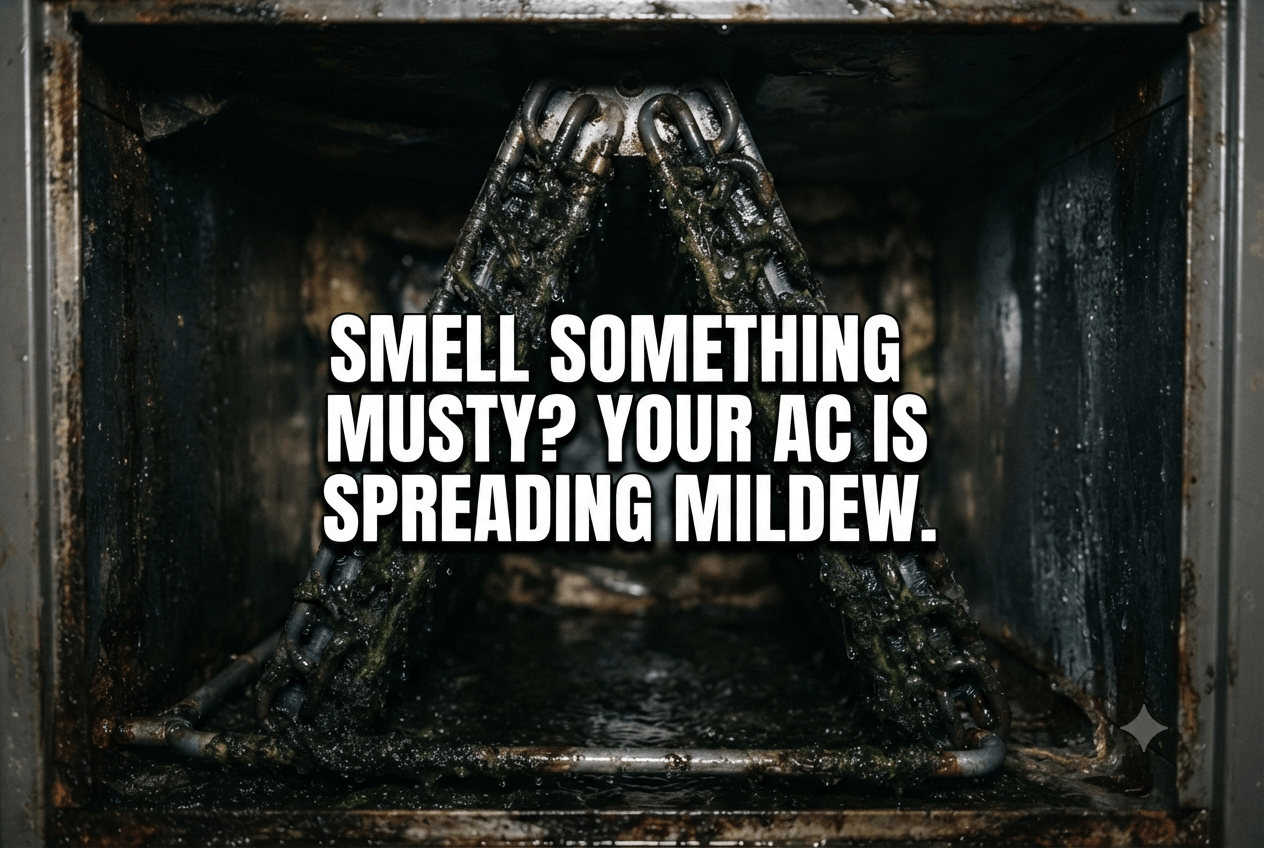
Mildew Smell in Air Conditioner is a incredibly common household problem, but it is not something you should ignore. That musty scent is a direct warning sign that active microbial growth is flourishing inside your cooling system. Every time your system turns on, it isn’t just cooling your home—it is actively blowing microscopic mold spores and musty air into the rooms where your family breathes, sleeps, and eats.
At The Duct Pros, we specialize in complete system sanitation and odor elimination to restore healthy, fresh airflow to your home. While we do not install new HVAC units or offer mechanical AC repairs, our core expertise lies in deep-cleaning the hidden air paths and ductwork where odor-causing mildew loves to hide.
1. Mildew Smell in Air Conditioner Why ?
Your air conditioner does more than just lower the temperature; it also dehumidifies your home. As warm, humid indoor air passes over the freezing cold evaporator coils, moisture condenses on the metal fins—much like condensation forming on a cold glass of water.
The Perfect Breeding Ground: Under normal circumstances, this moisture drips safely into a drain pan and flows outside. However, if your system’s air filter lets dust, pet dander, and organic debris bypass the barrier, that debris sticks to the wet coils.
Darkness and Moisture: This combination of constant dampness, darkness, and a rich organic food source (dust) creates the absolute perfect breeding ground for mold and mildew to thrive directly on your cooling coils and inside your ductwork.
2. The Dangers of Ignoring a Musty HVAC System
A smelly air conditioner is highly unpleasant, but the real risks extend far beyond a bad odor.
Respiratory Irritation: Breathing in air that constantly circulates through a mildew-infested coil can trigger allergy flare-ups, persistent coughing, throat irritation, and headaches.
Spread of Spores: If left unaddressed, active mold and mildew inside your HVAC unit can release spores that travel through your ductwork and eventually settle on your carpets, drywall, and furniture, leading to widespread mold issues in your home.
System Inefficiency: When mildew and dust form a thick, insulating blanket over your evaporator coils, it restricts airflow and prevents the refrigerant from absorbing heat efficiently, causing your energy bills to spike.
3. How to Locate and Eliminate the Source of the Odor
Masking the smell with air fresheners or scented candles will not solve the underlying issue. To get rid of the musty smell permanently, you must target the source:
Inspect the Condensate Drain Line: If your AC’s drain line becomes clogged with algae and slime, water will back up into the drain pan beneath your unit. This standing, stagnant water quickly turns moldy and sends a strong musty smell right back up into your living spaces.
Examine the Evaporator Coils: Because the coils are hidden deep inside your indoor air handler unit, they are difficult to access without professional tools. If they are coated in grey or black grime, they require a deep chemical flush.
Clean the Supply Ducts: If mildew spores have migrated from the coils into the dark, dusty interior of your supply ductwork, the entire ventilation path must be thoroughly agitated and vacuumed clean to prevent the smell from returning.
4. Professional Sanitation by The Duct Pros
Standard household cleaning sprays cannot reach—or safely clean—the complex internal components of your HVAC system.
At The Duct Pros, we use a multi-step restoration process to wipe out odor-causing mildew at the source:
Negative Pressure Extraction: We hook up our truck-mounted HEPA vacuum systems to pull loose dust and organic debris out of your ducts so mold has nothing left to feed on.
EPA-Approved Sanitizers: We apply specialized, non-toxic, HVAC-safe antimicrobial sanitizers directly to your system’s interior surfaces. This sanitization process doesn’t just mask the musty scent—it actively neutralizes the bacteria, mold, and mildew spores on contact, leaving your air completely clean and fresh.
Stop breathing in musty, contaminated air. Reclaim your home’s freshness by scheduling a professional system sanitation with our team today.
📞 (866) 712-1122
📧 Info@theductpros.us
🎯 Frequently Asked Questions About Mildew AC Odors
Can a dirty air filter cause a mildew smell?
Yes. If an air filter is left unchanged for too long, it will absorb moisture from the humid summer air. Dust and organic material trapped on the damp filter will quickly begin to grow mold and mildew, spreading a musty smell throughout your entire house every time the blower fan runs.
How do I know if the smell is mildew or a gas leak?
Mildew has a very distinct earthy, damp, musty, or “dirty sock” smell. A gas leak, on the other hand, will smell like rotten eggs or sulfur due to additives placed in natural gas. If you smell rotten eggs, turn off your gas line immediately, leave the house, and call your utility company.
Will running the AC “fan only” mode help dry out the mildew?
Running your HVAC fan in the “ON” position instead of “AUTO” can help keep air moving, but it will not kill or remove established mildew. Once mold or mildew has bonded to your coils or ductwork, it must be physically cleaned and chemically sanitized to stop the odor.