

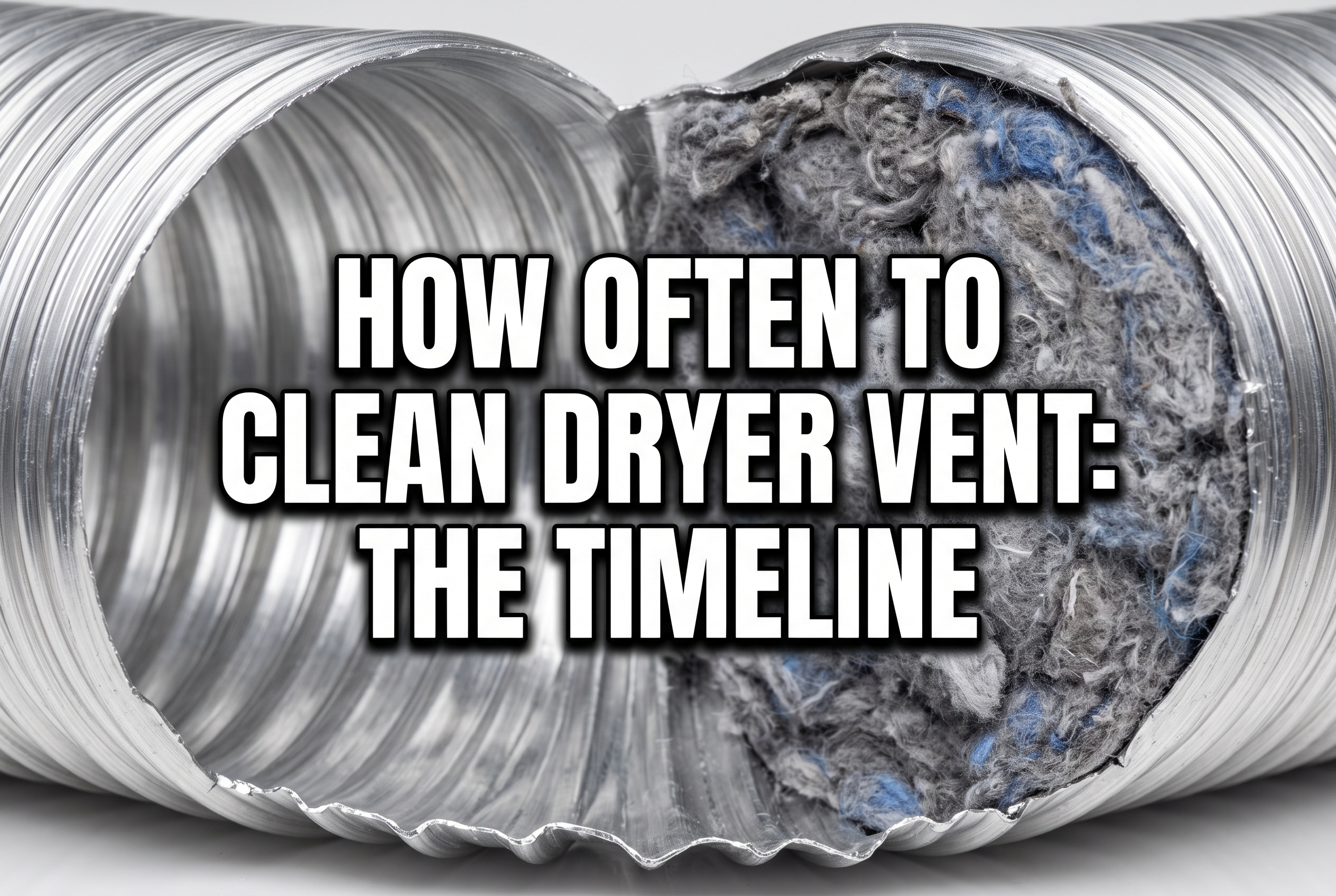
how often to clean dryer vent lines to prevent a catastrophic appliance fire? One of the most dangerous misconceptions in residential home maintenance is assuming that cleaning the small lint trap screen inside your clothes dryer is enough to protect your home. While emptying that screen after every load is mandatory, it only catches about 80% of the lint. The remaining 20% is blown directly into the hidden exhaust ductwork inside your walls.
Unlike your HVAC system, which circulates ambient air, your dryer exhausts intense thermal energy, moisture, and highly combustible material. When that lint builds up, it fundamentally changes the thermodynamics of the machine, creating an immense hazard that kills efficiency and threatens your property.
At The Duct Pros, our core mission revolves around high-velocity pneumatic lint extraction and total exhaust line restoration. We understand the physics of appliance airflow. Here is a technical breakdown of the proper maintenance timeline, the variables that accelerate lint buildup, and why professional extraction is a mandatory annual investment.
1. The Industry Standard: The 12-Month Baseline
For the average residential household, the timeline is strict and straightforward.
Annual Extraction: Under normal operating conditions (a standard family of four doing a few loads of laundry a week), you must schedule a professional dryer vent cleanout once every 12 months.
The Accumulation Rate: Over the course of a year, the microscopic lint fibers that bypass the internal trap will slowly coat the ridges of the exterior exhaust pipe. By month twelve, this coating typically becomes thick enough to cause significant aerodynamic friction, forcing the dryer’s blower motor to work overtime.
2. Variables That Accelerate the Schedule
Certain lifestyle and architectural factors require you to clean the vent every 6 to 8 months.
Large Families and Heavy Usage: If you have a large family doing multiple loads of laundry every single day, the volume of bypassed lint scales exponentially.
Pets and Heavy Fabrics: Homes with multiple heavy-shedding pets, or households that frequently wash heavy cotton towels and thick bedding, generate significantly more lint per cycle, clogging the exhaust pipe twice as fast as lightweight clothing.
3. The Danger of Vertical and Roof Venting
The architecture of your home dictates how hard your dryer has to work.
Fighting Gravity: If your laundry room is in the center of the house on the ground floor, the vent pipe likely travels vertically up through the walls and exhausts out of the roof. Pushing heavy, wet lint 20 feet straight up against gravity requires perfect airflow.
Faster Clogs: Vertical runs accumulate lint much faster than short, horizontal runs that exit directly out a side wall. If your vent exhausts through the roof, a strict 12-month schedule is non-negotiable, and 8 months is often recommended to prevent severe blockages.
4. Warning Signs You Cannot Wait for the Schedule
If you experience any of these symptoms, you must ignore the calendar and call immediately.
Scorching Hot Appliance: If the top of the dryer cabinet is too hot to comfortably touch during a cycle, the thermal energy is backing up.
Damp Clothes After One Cycle: If a standard 60-minute cycle leaves your clothes incredibly hot but still damp, the exhaust pipe is fully choked. The moisture has nowhere to go and is simply recirculating inside the drum.
5. Professional High-Velocity Lint Extraction
Clearing a severe lint log requires industrial tools, not a consumer vacuum.
Total Line Clearing: At The Duct Pros, we do not rely on standard shop-vacs or cheap plastic drill brushes that can puncture your flexible ducting. We utilize high-pressure pneumatic tools and industrial HEPA vacuums that travel the entire length of the exhaust line—from the laundry room to the roof. We blast the dense lint blockages apart, restoring peak aerodynamic flow and securing your home against fire hazards.
Stop risking your property and overworking your expensive appliances. Adhere to the proper maintenance timeline and secure your home by scheduling a professional dryer vent cleanout today.
📞 (866) 712-1122
🌐 www.theductpros.us
📧 Info@theductpros.us
🎯 Frequently Asked Questions About Dryer Vent Maintenance
How often to clean dryer vent: Does a short vent run still need to be cleaned yearly? Yes. Even if your dryer is located directly against an exterior wall with only a two-foot exhaust pipe, that short pipe and the exterior louvered hood will still become choked with sticky, wet lint. While the blockage may not stretch as far, the immediate restriction of airflow still creates a severe fire hazard and causes the appliance to overheat.
How often to clean dryer vent: Can I clean my own dryer vent to save money? Attempting to clean a dryer vent with a DIY hardware store brush kit is highly risky. These rigid nylon brushes frequently break off or get stuck on a screw deep inside the wall, leaving a massive permanent obstruction in the pipe. Furthermore, DIY tools only push the lint around; they lack the extreme negative vacuum pressure required to safely extract the flammable debris completely out of the home.
How often to clean dryer vent: Will cleaning the vent lower my electricity bill? Absolutely. A clogged dryer vent forces the appliance to run two or three full cycles just to dry a single load of laundry. Clothes dryers are high-draw electrical appliances. By restoring the aerodynamic exhaust flow, the dryer can finish a load in a single, shorter cycle, drastically reducing your monthly energy consumption.