
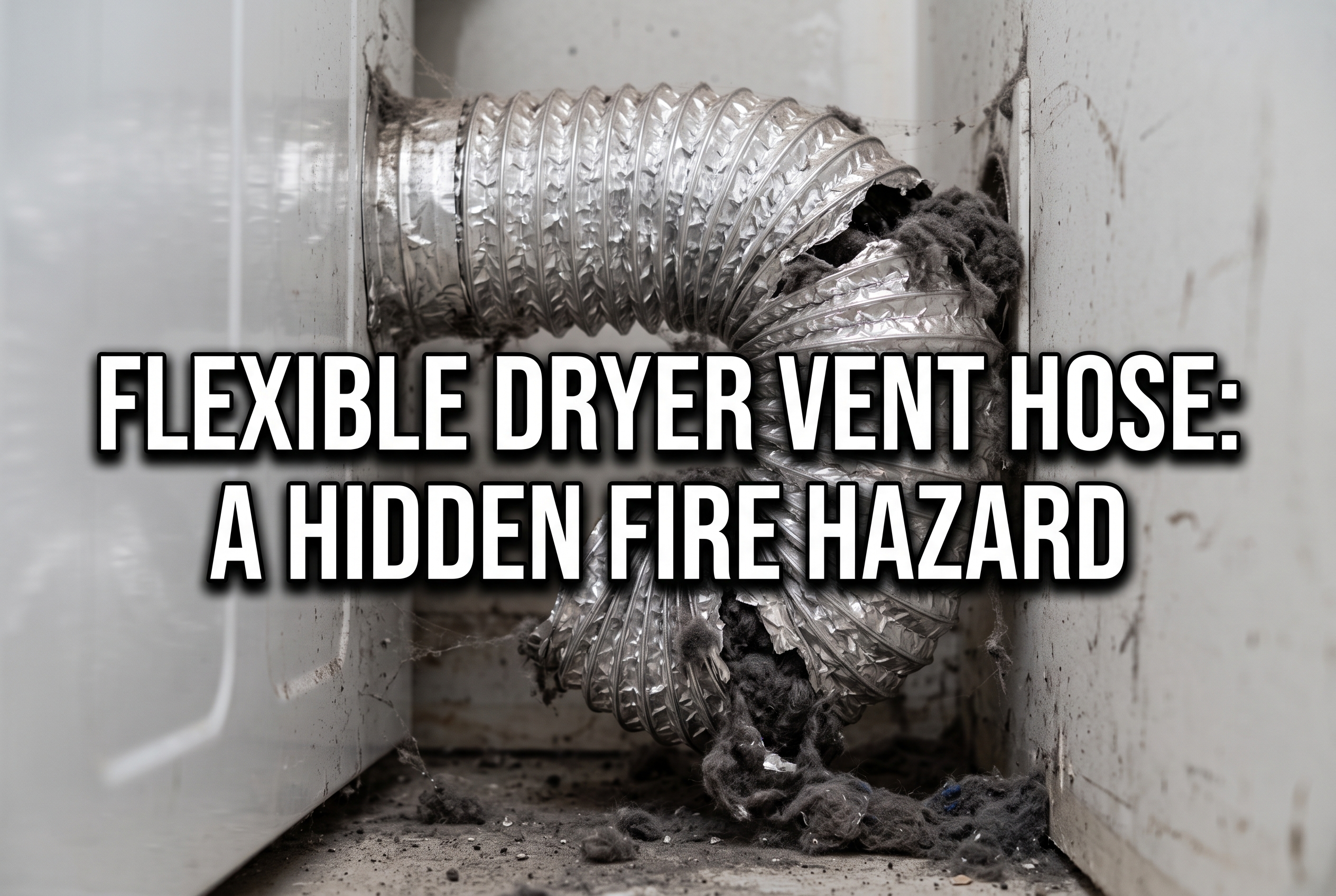
Flexible Dryer Vent Hose is a Major Fire Hazard, When setting up a laundry room, many homeowners push their clothes dryer against the wall without giving a second thought to the transition duct connecting the appliance to the exhaust pipe. Often, the builder or appliance delivery team installs a cheap, accordion-style flexible dryer vent hose made of thin plastic or delicate aluminum foil. While these slinky-like tubes are incredibly cheap and easy to bend, they represent one of the most significant fire hazards hiding in modern residential homes.
A clothes dryer relies on intense heat and rapid, high-velocity airflow to safely expel steam and flammable clothing lint out of your house. When you compromise that airflow with flimsy, ribbed materials, you create an immediate choke point that forces your appliance to overheat.
At The Duct Pros, we specialize in comprehensive dryer vent cleaning, obstruction removal, and airflow restoration. While we do not repair the internal mechanics of your dryer, our expertise is securing the ventilation path it relies on. Here is a technical breakdown of why that cheap foil hose is threatening your property and why a professional extraction and system upgrade is vital.
1. The Problem with Ribbed Interiors
The physical design of a flexible hose fundamentally works against the aerodynamics of your dryer.
Friction and Drag: The interior of a plastic or foil accordion hose is covered in deep ridges. As the high-velocity air leaves your dryer, it hits these ridges, creating massive friction and air turbulence.
The Lint Trap Effect: These ridges act like tiny speed bumps, catching microscopic lint fibers as they fly by. Unlike smooth, rigid metal pipes, a flexible dryer vent hose rapidly accumulates a thick, heavy layer of packed lint along its entire length, severely restricting the system within just a few months.
2. The Crush Factor
Flexible hoses are incredibly delicate and prone to physical failure in tight spaces.
Restricted Airflow: Because laundry rooms are often tight on space, homeowners naturally push the dryer back as close to the wall as possible. This instantly crushes the flexible hose, folding it in half or kinking it at a sharp angle.
Thermal Backup: A crushed hose blocks the exhaust completely. The intense heat generated by the dryer has nowhere to go, causing the internal cabinet temperature to skyrocket and risking the combustion of the trapped lint.
3. Punctures and Indoor Air Pollution
The thin foil or plastic used in these transition ducts cannot withstand long-term use.
Structural Tearing: The constant vibration of the dryer, combined with the heat and heavy lint buildup, quickly causes the foil or plastic to tear and puncture.
Leaking Carbon Monoxide: If you have a gas-powered dryer, a torn flexible hose will leak deadly carbon monoxide directly into your laundry room. Even with an electric dryer, a punctured hose blows hot steam and heavy dust all over your walls, causing mold and indoor air quality issues.
4. Code Violations and Insurance Risks
Using the wrong material can have legal and financial consequences.
Building Codes: Most modern municipal building codes and appliance manufacturer guidelines strictly prohibit the use of white plastic transition hoses and heavily restrict the use of thin foil hoses due to their high flammability.
Liability: If a fire starts in the laundry room and the insurance investigator discovers an illegal or non-compliant plastic hose was used, your homeowner’s insurance claim could be severely delayed or outright denied.
5. Professional Upgrades and High-Velocity Cleaning
Securing your laundry system requires proper materials and a completely clear exhaust line.
Rigid Metal Transition: At The Duct Pros, we highly advise replacing flimsy accordion hoses with smooth, rigid or semi-rigid heavy-duty aluminum piping. This ensures maximum aerodynamic flow and prevents crushing.
System Extraction: Replacing the transition hose is only the first step. We utilize industrial pneumatic tools to blast out the years of packed lint hidden inside the walls, ensuring your newly upgraded system exhausts perfectly from the dryer all the way to the exterior roof or wall.
Don’t let a ten-dollar piece of foil threaten your home. Protect your property, lower your drying times, and prevent appliance fires by scheduling a comprehensive dryer vent cleanout today.
📞 (866) 712-1122
🌐 www.theductpros.us
📧 Info@theductpros.us
🎯 Frequently Asked Questions About Dryer Vent Hoses
Flexible dryer vent hose: Is a plastic dryer vent hose safe to use? Absolutely not. White plastic or vinyl accordion hoses are highly flammable, illegal under most modern building codes, and strictly prohibited by dryer manufacturers. If a lint fire sparks inside the dryer, the plastic hose will immediately melt and ignite, rapidly spreading the fire to the surrounding drywall.
Flexible dryer vent hose: How do I know if my hose is crushed? The most common indicator of a crushed transition hose is an extreme increase in drying times. If a normal load of laundry is suddenly taking two or three cycles to dry, or if the top of the dryer cabinet feels scorching hot while running, the hose is likely crushed or severely clogged with lint.
Flexible dryer vent hose: What is the best material for a dryer vent transition? The safest and most efficient material is rigid, smooth-walled galvanized steel or aluminum piping. If the space is too tight for rigid pipe, heavy-duty semi-rigid aluminum ducting is the next best alternative, as it maintains its shape better than cheap foil and will not ignite during a lint fire.