

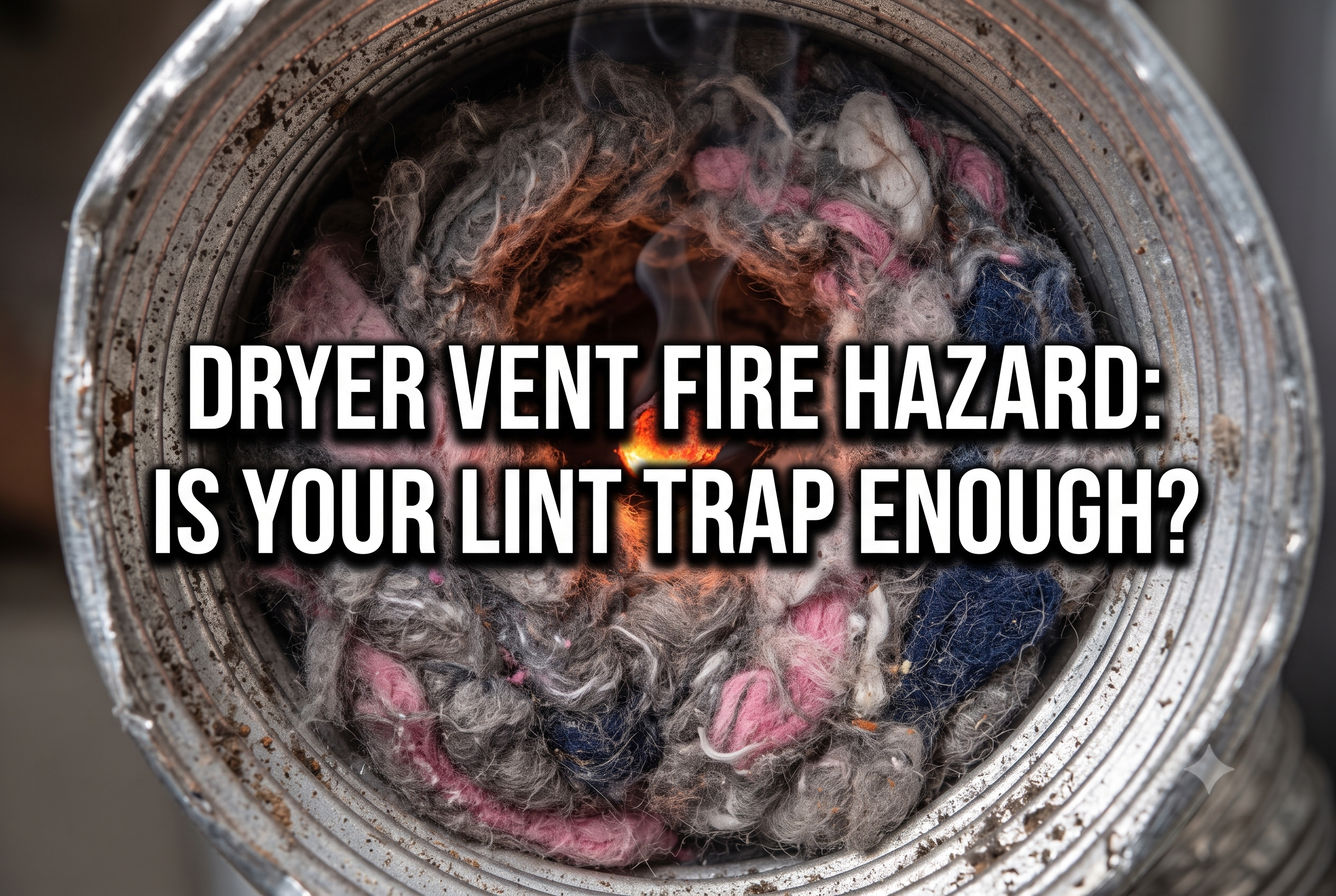
Dryer vent fire hazard is one of the most serious, yet preventable, safety risks facing homeowners today. When you think of household dangers, you likely prioritize locking doors, installing smoke detectors, and testing your carbon monoxide monitors. However, nestled in your laundry room sits an appliance that, if neglected, poses a significant risk of catastrophic structural fire: your clothes dryer.
Every single time you run a load of laundry, your dryer generates intense heat and humidity to evaporate moisture from your clothes. While your lint trap catches a large percentage of the resulting fabric fibers, it is estimated that nearly 30% of this highly flammable debris bypasses the screen and enters the hidden exhaust duct. Over months and years of regular use, this material accumulates, creating a dense, restrictive, and incredibly volatile blockage within your home’s ventilation system.
At The Duct Pros, we specialize in professional, high-velocity Dryer Vent Cleaning and comprehensive air system maintenance. While we do not handle appliance installations, our core expertise lies in identifying dangerous airflow restrictions and completely extracting them to protect your property. Here is a technical breakdown of why lint is a severe fire hazard, the warning signs of a blockage, and why professional maintenance is mandatory for home safety.
1. The Science of Lint Combustion
To understand the risk, you must understand the fuel. Clothing lint is composed of microscopic fibers from natural and synthetic fabrics. These fibers are extremely dry, lightweight, and have a massive surface-to-volume ratio.
The Combustion Threshold: When a vent is clogged, airflow stalls. This causes the internal temperature of the dryer’s cabinet and exhaust pipe to skyrocket, often exceeding 500°F (260°C).
The Spark: At this temperature, the superheated, trapped lint near the heating element or gas burner requires only a minor spark—often generated by the appliance’s internal electrical components—to ignite instantly.
The Chimney Effect: Once lit, the highly pressurized exhaust duct acts exactly like a chimney. It provides a continuous oxygen supply to the fire, drawing the flames rapidly deep into your walls, ceilings, or attic space before a smoke alarm in the laundry room even activates.
2. Critical Warning Signs of a Clogged Dryer Vent
Your dryer will actively signal that it is struggling long before a fire ignites. Ignoring these clogged dryer vent symptoms is a dangerous gamble.
Extended Drying Times: The most common sign is that standard loads of towels or jeans suddenly require two or three cycles to dry completely. The trapped moisture cannot escape the drum, forcing the appliance to continuously recirculate damp air over the clothes.
The Dryer is Scorching Hot: If the exterior cabinet of your dryer feels intensely hot to the touch while running, it means the heat is backing up inside the machine. This indicates severe backpressure from a downstream blockage.
A Burning Odor: If you ever detect a musty, acrid, or distinct burning smell when the dryer is operating, shut it off immediately. This odor is the smell of lint near the heating element reaching its combustion point.
No Airflow at the Exhaust Vent: You can test your own system by stepping outside while the dryer is running and placing your hand near the exterior vent hood. If you cannot feel a strong, forceful flow of warm air, your system is obstructed.
3. Why Your Internal Lint Trap Is Not Enough
Relying solely on the primary lint screen inside the dryer door is a common misconception that leads to devastating consequences.
The 30% Rule: The primary filter only captures about 70% of the lint produced during a cycle. The remaining fine particulate passes directly through the blower fan and into the exhaust duct.
Hidden Accumulation: The vast majority of the fire hazard accumulates in the 10, 15, or even 20 feet of venting pipe that is hidden inside your walls, under your house, or in the attic, making it impossible for the homeowner to monitor visually.
4. Our Professional High-Velocity Lint Extraction
A homeowner cannot effectively clear a long, complex vent run with a consumer brush kit. These kits often fail to remove packed blockages or, worse, snap off inside the pipe.
Pneumatic Reverse-Skipping: At The Duct Pros, we utilize industrial, truck-mounted HEPA vacuums and specialized pneumatic tools that we feed into the vent from the exterior of the home. These tools blast high-pressure air backward, shattering and pulling out impacted logs of lint.
System Verification: After the physical extraction is complete, we perform a final static pressure test to guarantee that the airflow velocity has been perfectly restored to factory safety standards.
Do not wait for a burning smell to address your laundry system’s ventilation. Protect your home from the significant threat of lint fires and restore your appliance’s efficiency by scheduling a comprehensive dryer vent cleanout today.
📞 (866) 712-1122
🌐 www.theductpros.us
📧 Info@theductpros.us
🎯 Frequently Asked Questions About Dryer Vent Fire Hazards
Dryer vent fire hazard: How often should a dryer vent be cleaned professionally? For most households, a professional dryer vent cleaning should be performed once every 12 months. However, if you have a large family that runs multiple loads daily, or if your duct run is exceptionally long with multiple 90-degree elbows, it should be inspected and cleaned every 6 months.
Dryer vent fire hazard: What happens if a dryer vent is not vented properly? Improper venting, such as terminating into an attic, crawlspace, or using non-code compliant materials (like flexible foil or plastic ducting), significantly compounds the fire hazard. Lint will accumulate more rapidly in restrictive ducting, and exhausting hot, moist air into an enclosed structural space leads to dangerous mold and rot.
Dryer vent fire hazard: Can cleaning the vent yourself prevent a fire? While cleaning the visible section behind the dryer is helpful, it is insufficient to address blockages deep within the wall or near the exterior termination. Professional, high-velocity extraction is required to clean the entire length of the exhaust line safely and effectively.