
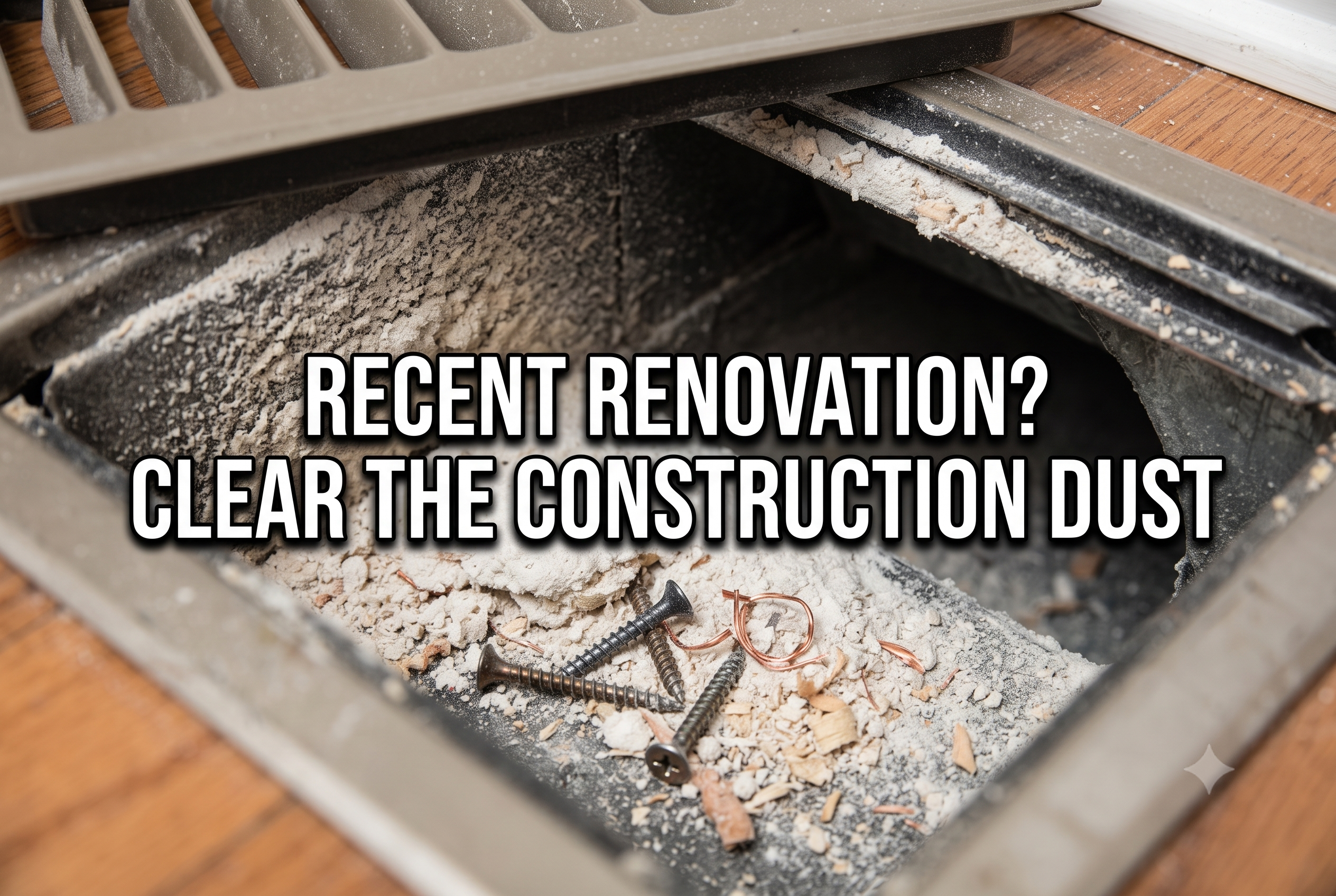
Construction Dust in Air Ducts, Completing a home renovation or remodel is incredibly exciting. You finally get to enjoy your new kitchen, bathroom, or addition. However, months after the contractors have left, many homeowners find themselves facing a frustrating and persistent issue: fine, white dust constantly settling on every surface. This isn’t normal household dust; it is highly abrasive construction dust in air ducts, and it indicates that your HVAC system was running unprotected during the project.
During any renovation—from installing new sheetrock to refinishing hardwood floors—millions of microscopic dust particles are aerosolized. Contractors are focusing on your finishes, not your ventilation system. Unless the return air vents were hermetically sealed, your blower motor was actively sucking these heavy particulates straight into your ductwork and recirculating them throughout your finished home.
At The Duct Pros, we provide complete high-particulate extraction and chemical sanitization. While we do not handle new equipment installations, our core expertise is rescuing compromised ventilation systems from severe contamination. If your home flip or remodel left behind a constant, invisible mess, here is the technical breakdown of why construction dust in air ducts occurs, the health risks it poses, and how professional HEPA extraction is mandatory to reclaim your indoor air quality.
1. How Sheetrock Dust Infiltrates the HVAC System
Renovation particulates are fundamentally different and more damaging than standard household dust.
Returns Sucking Powder: The moment a sheetrock saw spins or a sander activates, a plume of fine silica or sawdust is released. Your home’s HVAC system relies on large “return vents” that pull air in to be conditioned. If these returns were not properly blocked during construction, they acts as powerful vacuum intakes, pulling this entire plume deep into the duct network.
Settled Contamination: Because this dust is incredibly heavy and fine, it rapidly settles in the low-velocity bends and corners of your supply and return lines, coating the interior metallic walls in a thick layer of microscopic grit.
2. The Severe Microscopic Health Risks
Breathing renovation particulates is hazardous, far exceeding standard indoor allergy issues.
Aerosolized Silica: Sheetrock, drywall mud, and tile grout contain fine crystalline silica. When aerosolized and inhaled, these microscopic, jagged particles become deeply embedded in lung tissue, potentially leading to chronic respiratory distress and, in severe cases, pulmonary conditions. Sawdust, particularly from treated wood, contains dangerous chemical binders and resins that are equally hazardous when continuously recirculated in your home.
3. Clogging the Coils and Blower Motor
The negative impact of construction dust in air ducts extends directly to your mechanical equipment’s efficiency and lifespan.
Insulating the Evaporator Coil: Dust that bypasses your primary filter will inevitably find its way to the AC’s wet evaporator coil. The fine white powder turns into a dense, wet, plaster-like sludge on the metallic fins, creating a powerful insulating barrier that suffocates the system. This blocks efficient heat transfer, forces your compressor to work drastically harder, spikes your energy consumption, and shortens the life of your expensive system.
Unbalancing the Blower: Heavy dust accumulation on the blower motor blades alters their aerodynamic balance, causing the motor to vibrate excessively, draw too much current, and eventually burn out prematurely.
4. Total Particulate Extraction and Sanitization
Changing your air filter monthly cannot solve a construction dust problem that is rooted inside the ductwork.
Negative Air Containment: At The Duct Pros, we utilize industrial, truck-mounted HEPA vacuum systems. We place your entire ventilation network under intense negative pressure, ensuring that as we disturb the packed sheetrock dust, none of it blows back into your newly finished living spaces.
High-Torque Pneumatic Scouring: We deploy specialized pneumatic agitation tools and whips that scour the interior metallic walls, shattering the caked-on powder. Once the physical debris is entirely removed, we apply an EPA-registered anti-static treatment that helps prevent fine particles from clinging to the walls again, fully restoring your air path to factory cleanliness.
Don’t let hidden renovation powder continue to contaminate your finished home and your family’s health. Reclaim your indoor air quality by scheduling a comprehensive post-renovation duct cleanout today.
📞 (866) 712-1122
🌐 www.theductpros.us
📧 Info@theductpros.us
🎯 Frequently Asked Questions About Construction Dust in Ductwork
Construction dust in air ducts: Why is there so much white dust after my renovation? The “white dust” is typically sheetrock or drywall dust, composed of fine crystalline silica. If return vents were not properly sealed during your remodel, your HVAC system actively sucked this fine powder into the ductwork, where it now continuously recirculates throughout the home every time the blower turns on. Standard household filters cannot stop this fine particulate.
Construction dust in air ducts: Can I clean construction dust from vents myself? Standard household vacuums and consumer brush kits cannot safely remove construction dust. They lack the high negative pressure and high-torque agitation needed to scour the compacted powder from metallic ducts. Attempting this often results in releasing more hazardous, silica-laden dust into your home. Professional HEPA extraction is mandatory to safely eliminate this contamination.
Construction dust in air ducts: How often should I clean my ducts after a renovation? For residential properties that recently underwent construction, a single professional HEPA extraction cleaning immediately following the completion of the project is usually sufficient to address the construction contamination. Thereafter, your home should return to a standard cleaning schedule of every 3 to 5 years for general air quality maintenance.