

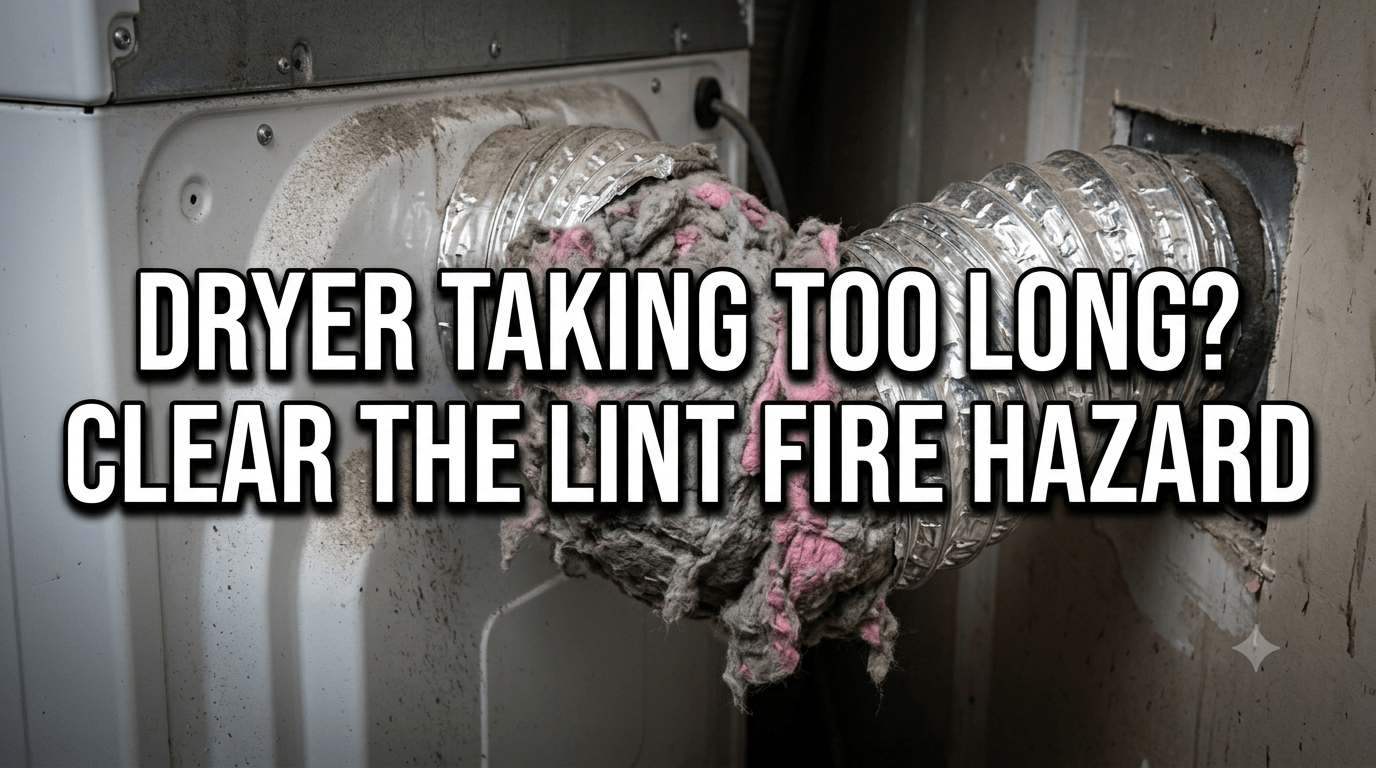
Clogged dryer vent symptoms are universal home fire hazard, When homeowners think about home maintenance, they usually look at visible projects or major mechanical systems. One of the most critical, potentially life-saving maintenance tasks is completely hidden from view: cleaning your clothes dryer’s exhaust line. Unlike heating or cooling issues, dryer vent failure isn’t a seasonal problem. Whether it is the dead of winter or the peak of summer, your dryer faces the exact same structural workload every week.
Every time you wash a load of laundry, your clothes shed millions of tiny fabric fibers. While your dryer’s internal lint trap is designed to catch the bulk of this debris, it only captures about 70% of it. The remaining 30% passes straight through the screen and enters the hidden exhaust line that routes the hot, moist air out of your house. Over time, this highly flammable material lines the interior walls of your pipe, slowly restricting airflow until your appliance becomes a ticking time bomb.
At The Duct Pros, we provide expert, high-velocity Dryer Vent Cleaning alongside our air quality restoration services. While we do not provide appliance or HVAC installation services, we specialize in identifying dangerous airflow blockages and fully extracting them to protect your property. Here is a technical breakdown of the universal clogged dryer vent symptoms you need to watch out for, the mechanics of lint combustion, and how professional extraction keeps your home safe.
1. Clothes Taking Multiple Cycles to Dry
The most common, immediate indicator of a ventilation restriction is a sudden drop in your appliance’s drying efficiency.
The Airflow Barrier: A dryer works by continuously forcing high-temperature air through the tumbling drum to evaporate moisture from your clothes. This hot, wet air must be exhausted out of the house instantly.
The Backpressure Loop: If the exhaust pipe is lined with an inch of thick lint, the air cannot escape. The moist air is trapped inside the drum, continually recirculating over your laundry. If a standard load of towels suddenly takes two or three cycles to dry completely, your vent is severely restricted.
2. The Top of the Dryer is Scorching Hot
A dryer is engineered to handle high temperatures, but it relies on constant airflow to keep its internal components from overheating.
Thermal Energy Buildup: When a clog creates backpressure, the intense heat generated by the electric heating element or gas burner has nowhere to go. It backs up directly into the dryer’s cabinet.
Component Degradation: If the top or side of your dryer cabinet feels intensely hot to the touch during a cycle, the system is overheating. This excessive thermal buildup rapidly degrades internal safety switches, melts electrical wiring, and drastically shortens the lifespan of your appliance.
3. A Heavy, Burning Smell in the Laundry Room
If you ever smell a distinct, smoky, or burning odor while running a load of laundry, you must shut the appliance off immediately.
The Combustion Threshold: Clothing lint is one of the most volatile, fast-burning fuels found in a residential home. When the internal temperatures of an unvented dryer skyrocket, fine lint particles floating near the heating element can easily ignite.
The Chimney Effect: Once a spark catches the lint inside the dryer, the exhaust pipe acts exactly like a chimney. It feeds oxygen directly to the fire, drawing the flames deep into your walls or attic space where the pipe is routed, leading to catastrophic structural damage.
4. The Exterior Vent Flap Stays Closed
You can easily diagnose a severe blockage by stepping outside your home while the dryer is actively running a cycle.
The Flap Test: Locate the plastic or metal termination hood on the exterior wall of your house. When the dryer is operating, the airflow should force the louvers or flap wide open, and you should feel a powerful, warm breeze escaping.
Total Stagnation: If the exterior flap remains closed, moves only slightly, or if you notice heavy lint nesting around the outside grid, the pipe is completely choked. The air velocity has dropped below the threshold required to even open the safety door.
5. Professional High-Velocity Lint Extraction
A standard household vacuum or a flexible consumer brush kit cannot safely clear a long, complex dryer vent line. In fact, cheap DIY brush kits frequently snap off inside the wall, making the blockage significantly worse.
Pneumatic Reverse-Skipping: At The Duct Pros, we utilize specialized pneumatic tools that travel deep into your exhaust line from the outside. These tools blast high-pressure air backward, creating a powerful venturi effect that pulls entire sheets and tightly packed logs of impacted lint completely out of the pipe.
Static Pressure Testing: After the physical extraction is complete, we run a digital static pressure test to verify that the airflow velocity has been perfectly restored to factory specifications. This drastically reduces your monthly energy costs and eliminates the primary cause of residential dryer fires.
Don’t wait for a warning light or a smoky smell to address your laundry system’s ventilation. Protect your home from the universal threat of lint fires and restore your appliance’s efficiency by scheduling a comprehensive dryer vent cleanout today.
📞 (866) 712-1122
🌐 www.theductpros.us
📧 Info@theductpros.us
🎯 Frequently Asked Questions About Clogged Dryer Vents
How often should a residential dryer vent be cleaned? For the vast majority of households, a professional dryer vent cleaning should be performed once every 12 months. However, if you have a large family that runs multiple loads of laundry daily, or if your dryer vent line is exceptionally long (over 15 feet) or has multiple 90-degree elbows, it should be inspected and cleaned every 6 months to prevent rapid lint accumulation.
Can a clogged dryer vent cause a house fire? Yes, absolutely. According to national fire safety data, restricted dryer exhaust lines are one of the leading causes of residential structural fires. Dry clothing lint is highly flammable. When airflow is blocked, the internal temperature of the dryer spikes until the lint near the heating element reaches its combustion point, sending flames rapidly through the exhaust pipe.
Why does my dryer feel incredibly hot to the touch? If the exterior cabinet of your dryer feels dangerously hot while running, it means the hot air is trapped. A heavy accumulation of lint inside the vent pipe is preventing the appliance from exhausting the heat. This backpressure forces the thermal energy to sit inside the machine, overheating your clothes and straining the internal electrical components.