
Cleaning air ducts after a rodent infestation is an absolute, non-negotiable medical necessity for any homeowner who has recently battled mice, rats, squirrels, or raccoons inside their property. Hearing the scratching in your walls and ceilings is a nightmare, and finally getting an exterminator to eliminate the pests brings a massive wave of relief. However, most homeowners falsely believe that once the traps are empty and the scratching stops, the problem is entirely solved.
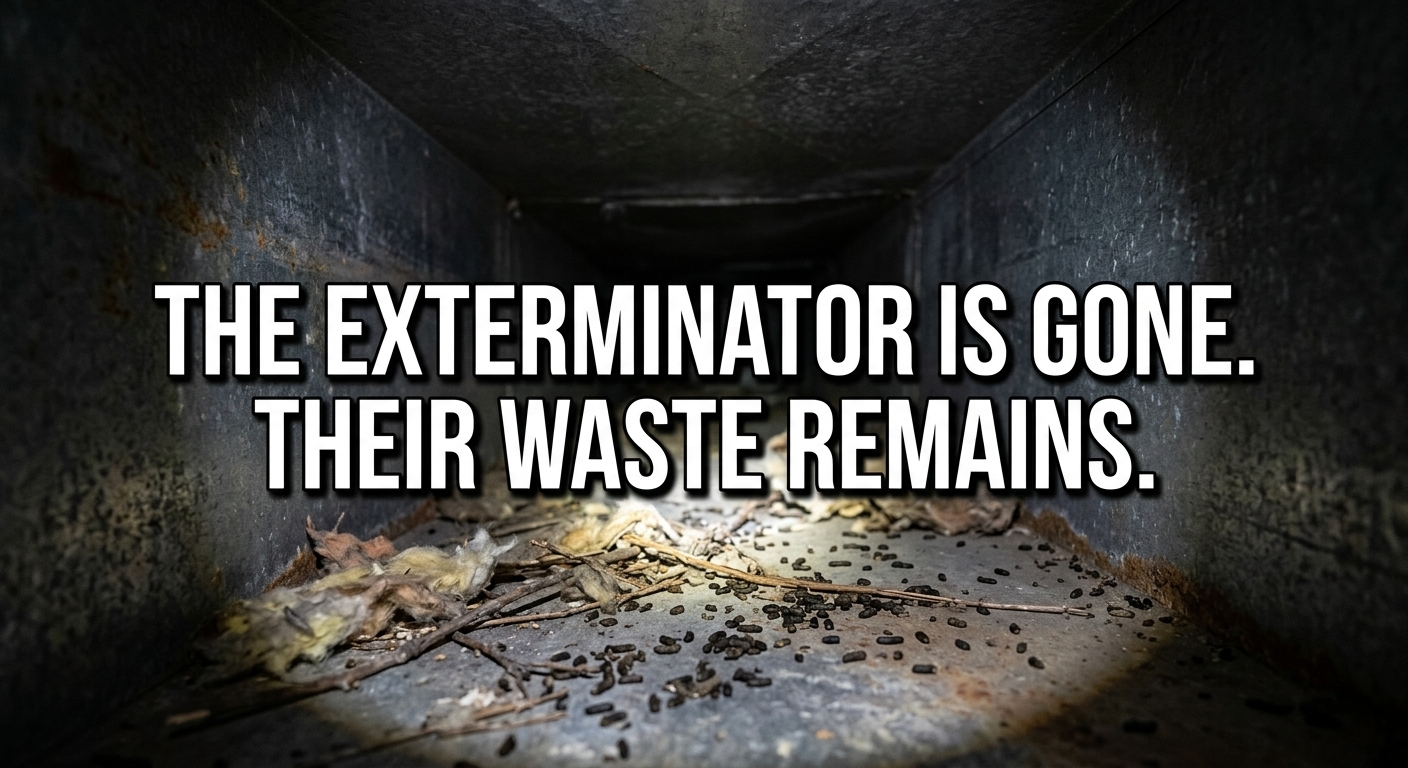
Unfortunately, exterminators only address the living animals. They do not remove what the animals left behind in your hidden ventilation system. If a rodent breached your HVAC ductwork, they used your metal and flexible pipes as a highway, a bathroom, a breeding ground, and occasionally, a graveyard.
At The Duct Pros, we specialize in post-infestation biohazard recovery. We see firsthand the horrific conditions inside ductwork after a pest control company has finished their job. If you want to protect your family from severe respiratory hazards and biological pathogens, here is a comprehensive, unfiltered breakdown of exactly why scheduling a professional source-removal extraction is mandatory after dealing with rodents in your home.
1. The Invisible Biohazard of Droppings and Urine
The most immediate threat to your indoor air quality is the biological waste left inside the enclosed spaces of your air ducts.
Toxic Accumulation: A single mouse can produce up to 100 droppings a day and constantly micro-urinate as it travels to mark its territory. If a family of mice lived in your ductwork for a month, you have thousands of droppings and soaked urine patches drying out inside the metal pipes.
The Aerosolization Effect: When rodent feces and urine dry out, they become extremely brittle and turn into a fine, highly toxic dust. Your HVAC system is essentially a giant wind tunnel. Every single time your furnace or air conditioning blower motor turns on, it violently blasts air across this dried waste, aerosolizing the microscopic biological particles.
Severe Health Risks: The Centers for Disease Control and Prevention (CDC) explicitly warns against breathing aerosolized rodent waste due to the risk of Hantavirus Pulmonary Syndrome, Salmonella, and severe allergic reactions. If you do not physically extract this waste, your HVAC system will continuously pump these pathogens directly into your bedrooms and living spaces.
2. Nesting Materials and Severe Airflow Restriction
Rodents seek out ductwork because it provides a warm, dark, and highly protected environment perfect for raising their young.
Building the Nest: To build their nests, mice and rats will tear up anything they can find. They drag shredded paper, leaves, twigs, stolen fabrics, and massive chunks of your attic’s fiberglass insulation directly into the branch lines of your ventilation system.
The Blockage Factor: These nests do not just sit passively; they create massive physical blockages. A rat nest can entirely clog a 6-inch supply duct, cutting off airflow to specific rooms in your house.
HVAC Strain: When your system attempts to push conditioned air through these dense, matted nests, the static pressure spikes. This forces your blower motor to work twice as hard, leading to skyrocketing energy bills and premature, catastrophic failure of your expensive heating and cooling equipment.
3. The Horror of Decomposing Odors
One of the most distressing reasons homeowners call us after an infestation is the sudden, overwhelming stench that takes over the entire house.
The Hidden Casualties: Exterminators often use poison bait blocks to solve an infestation. The rodents eat the poison, seek out water, and retreat to the deepest, darkest parts of your home to die—which is almost always inside the inaccessible ductwork.
The Odor Distribution Machine: As a carcass begins to decompose inside a vent, the biological gases build up. Your HVAC system catches these gases and acts as a whole-home odor distribution network. The moment the fan kicks on, the sickening, sweet smell of decay is aggressively pushed out of every single register in the house.
Flea and Maggot Complications: A decomposing carcass inside your ductwork also attracts secondary pests, including flies, maggots, and fleas, which can then exit the floor registers and create an entirely new infestation inside your living areas.
4. Why Standard DIY Cleaning is Dangerous and Ineffective
Many homeowners attempt to solve this issue by taking the cover off their floor register and sticking the hose of their household vacuum down the pipe. This is highly dangerous and largely ineffective.
Spreading Pathogens: Standard shop-vacs and household vacuums do not have commercial-grade HEPA filtration. If you vacuum dry rodent feces, the exhaust of your vacuum will immediately blast the microscopic, toxic pathogens straight into the air you are breathing, actively contaminating the room.
Lack of Reach: A standard vacuum hose only reaches three to four feet. Rodents build their nests and deposit their waste deep within the trunk lines, often 15 to 20 feet away from the register.
5. The Professional Eradication and Sanitization Process
True remediation requires a sterile, heavily contained, multi-step process that eliminates both the physical mass and the microscopic bacteria.
Negative Air Containment: The Duct Pros hook your entire HVAC system up to a truck-mounted, high-powered vacuum. This places the ductwork under massive negative pressure. As we agitate the debris deep inside the pipes, the droppings, nests, and carcasses are sucked completely out of your house into our contained unit. There is absolutely zero blowback into your living space.
EPA-Registered Antimicrobial Fogging: Once the physical waste is removed, the interior of the ductwork is still coated in dried urine and bacteria. We complete the biohazard cleanup by applying an odorless, EPA-registered, hospital-grade antimicrobial fog. This fine mist coats the entire interior of the system, killing the remaining viruses, neutralizing the rotting odors, and restoring the ductwork to a completely sterile state.
Reclaim the Safety of Your Indoor Air
Surviving a pest infestation is stressful enough without the lingering anxiety of breathing in toxic biological waste. Do not let your HVAC system act as a pathogen delivery network. Protect your family’s health, eliminate the horrible odors, and ensure your home is truly clean from the inside out.
Contact The Duct Pros immediately for a discrete, emergency biohazard extraction and sanitization service.
📞 Company Name: The Duct Pros 📞 Phone Number: (866) 712-1122 🌐 Website: TheDuctPros.us 📧 Email: Info@TheDuctPros.us
🎯 Frequently Asked Questions About Rodents and Air Ducts (People Also Ask)
Can mice travel through air ducts? Yes, mice and rats frequently use air ducts as a primary travel network throughout a home. Because ductwork connects every room, rodents can bypass locked doors and solid walls to scavenge for food in the kitchen and safely return to their nests in the attic or basement without ever being seen.
Is it safe to clean mouse droppings out of air vents? No, it is highly unsafe to clean mouse droppings without proper protective gear and commercial HEPA-filtered negative air equipment. Sweeping or using a standard household vacuum on dried droppings will aerosolize the bacteria, putting you at severe risk of inhaling Hantavirus or other dangerous pathogens. It requires professional extraction.
Does duct cleaning remove dead mice? Yes. Professional source-removal duct cleaning utilizes heavy pneumatic agitation tools and massive negative pressure vacuums that can easily dislodge and extract heavy blockages, including large rodent nests and dead carcasses, from deep within the main trunk lines where a homeowner cannot reach.