
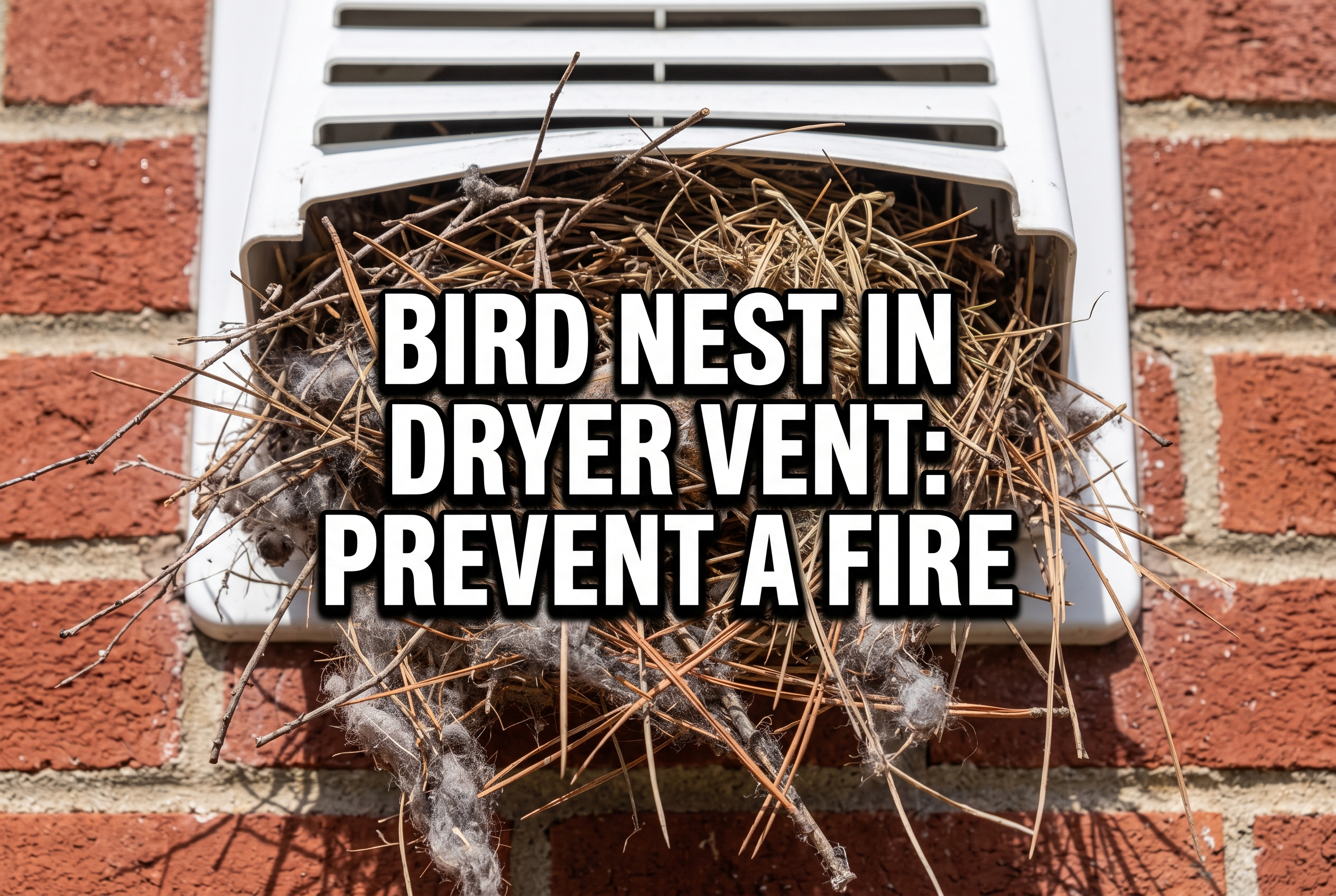
Bird nest in dryer vent piping is not just a minor nuisance; it is an immediate, high-risk fire hazard and a severe biological threat to your indoor air quality.As the seasons change and temperatures drop, local wildlife begins desperately searching for warm, dry places to build their homes. To a bird, the exterior exhaust hood of your laundry room looks like the ultimate luxury real estate.
Your clothes dryer relies on a clear, unobstructed aerodynamic pathway to expel intense heat, moisture, and highly flammable clothing lint out of your home. When a bird packs that four-inch metal pipe with tightly woven twigs and dry grass, the system is instantly paralyzed.
At The Duct Pros, we specialize in high-velocity physical extraction and total exhaust line restoration. We do not perform pest control exterminations, but once the birds have vacated, our core mission is extracting the massive, hazardous blockage they left behind. Here is a technical breakdown of why birds target your vents, the severe risks they pose, and how our professional extraction secures your home.
1. Why Birds Target Your Exhaust System
Your dryer vent offers everything a nesting bird needs to survive.
The Thermal Draw: The exhaust air blowing out of your dryer is incredibly warm. During the spring nesting season or cold winter months, this continuous blast of heat acts as a beacon for starlings, sparrows, and other small birds looking for a climate-controlled shelter.
Bypassing the Flaps: Standard builder-grade exterior vent covers feature lightweight plastic louvers (flaps) that easily blow open. Birds quickly learn how to push their beaks under these flimsy flaps, gaining direct access to the dry, secure, predator-free metallic pipe hidden inside your walls.
2. The Immediate Combustion Hazard
A bird nest fundamentally changes the physics of your dryer’s exhaust.
Highly Flammable Materials: Birds construct their nests using dry twigs, dead leaves, pine needles, and stolen dryer lint. This combination is literally the exact recipe used to make survival fire-starters.
Thermal Backup: Because this dense nest completely blocks the exhaust, the intense thermal energy generated by your dryer has nowhere to go. The heat backs up into the appliance, rapidly increasing the internal cabinet temperature until it is hot enough to ignite the dry twigs trapped in the pipe, causing a devastating wall fire.
3. Biological Contamination and Parasites
The danger does not disappear when the birds finally fly away.
Bird Mites and Droppings: Nests are crawling with microscopic bird mites, ticks, and heavily concentrated bird droppings. Because the nest is sitting inside your ventilation pipe, these parasites and the aerosolized bacteria from the droppings can easily find their way backward into your laundry room.
The Smell of Decay: If a bird or a hatchling unfortunately dies inside the deep ductwork, the smell of decay will be powerfully pushed back into your home every time the dryer runs, requiring immediate industrial extraction and sanitization.
4. Why DIY Removal Usually Fails
Attempting to pull a nest out with your hands or a coat hanger is highly risky.
The Compaction Risk: Bird nests can extend three to five feet deep into the pipe. If you reach in and try to blindly pull it out, you will often accidentally push the dense back-half of the nest deeper into an elbow joint inside the wall, making it permanently lodged and impossible to reach without tearing open your drywall.
5. Professional High-Velocity Extraction and Prevention
Clearing an impacted nest requires specialized industrial tools.
Pneumatic Scouring: At The Duct Pros, we utilize high-pressure pneumatic whips that travel the entire length of your exhaust line. These air-driven tools violently lash the compacted twigs and grass apart, while our massive vacuum pressure pulls 100% of the flammable debris, mites, and droppings safely out of your home.
Pest-Proof Guards: Once the line is clinically cleared and airflow is restored, we highly recommend upgrading your exterior hood to a heavy-duty, bird-proof dryer vent cover. This ensures maximum aerodynamic flow while permanently locking wildlife out of your infrastructure.
Do not let a small bird cause a massive appliance fire. Protect your home, restore your dryer’s efficiency, and eliminate biological hazards by scheduling a professional vent cleanout today.
📞 (866) 712-1122
🌐 www.theductpros.us
📧 Info@theductpros.us
🎯 Frequently Asked Questions About Vent Blockages
Bird nest in dryer vent: How do I know if there is a bird in my vent? The most obvious sign is visual: you will see twigs or grass hanging out of the exterior vent hood on the side of your house, or you will actively see birds flying back and forth to the vent. Internally, your dryer will suddenly take two or three cycles to dry a single load of clothes, and the top of the dryer cabinet will feel scorchingly hot to the touch.
Bird nest in dryer vent: Is it illegal to remove a bird nest from my vent? Under the Migratory Bird Treaty Act, it is illegal to destroy or remove an active nest that contains eggs or flightless hatchlings for certain protected species. However, invasive species like European Starlings and House Sparrows are not protected. It is always best to wait until the nest is inactive or vacated before having the hazardous debris professionally extracted.
Bird nest in dryer vent: Can I just put chicken wire over my vent to stop them? Absolutely not. You should never install chicken wire or standard screens over a dryer vent. The small mesh will instantly catch all the wet clothing lint blowing out of your house. Within a month, the screen will be completely permanently clogged with a solid wall of lint, creating the exact same severe fire hazard as the bird nest itself. You must use an approved, heavy-duty louvered pest guard.