

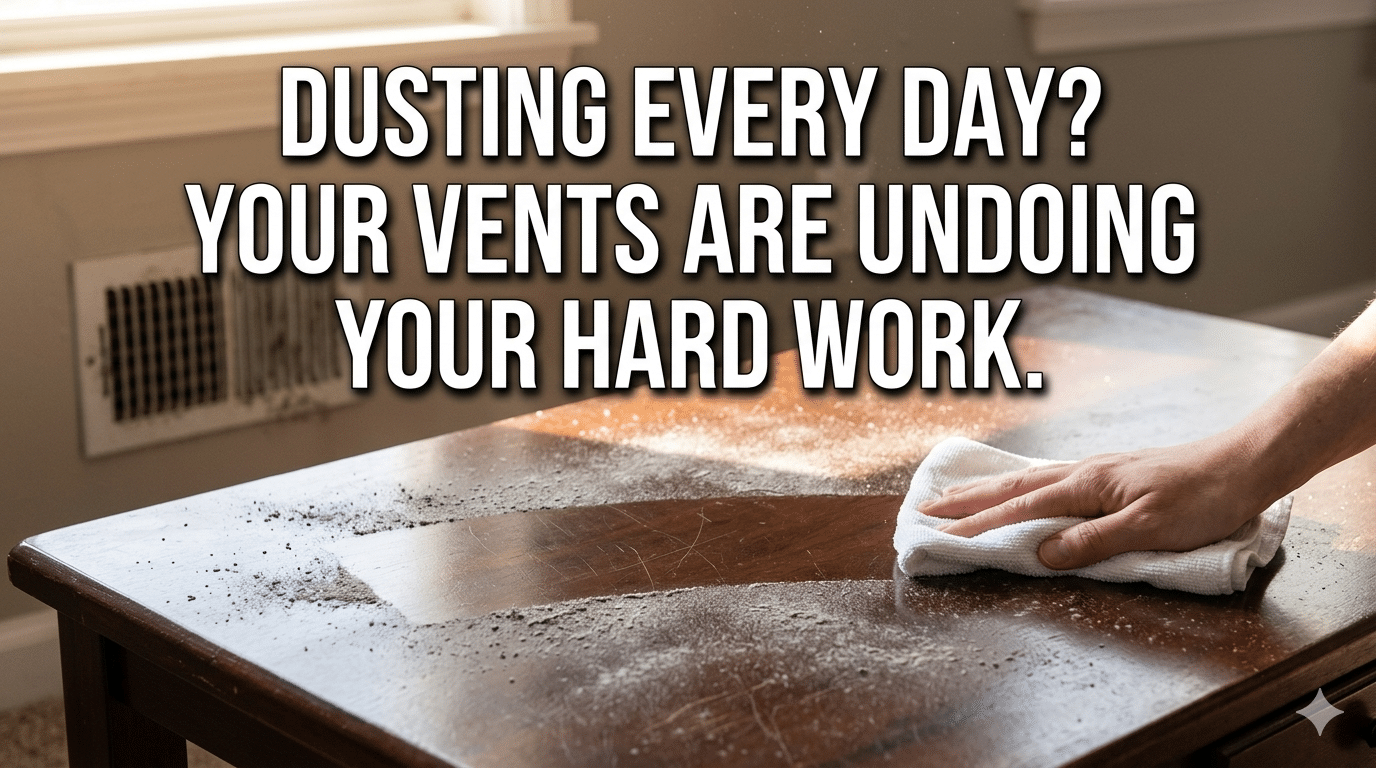
Air duct cleaning for excessive dust is the only permanent solution when you feel like you are trapped in an endless, unwinnable war against dirt in your own home. You know the exact frustration: you spend your entire Saturday morning deep-cleaning the house, meticulously wiping down the ceiling fan blades, dusting the television screen, polishing the dark wood furniture, and vacuuming the carpets. The house looks immaculate. Yet, barely 48 hours later, a highly visible, grey film has already settled right back onto every horizontal surface. You find yourself asking, “Where is all this dust coming from?”
The answer is hidden behind your walls. Your house is essentially a closed-loop respiratory system, and if the “lungs” of your home are contaminated, your surface cleaning is completely entirely futile.
At The Duct Pros, we frequently receive calls from exhausted homeowners who are desperate to understand why their homes get dirty so incredibly fast. While dusting is a normal part of homeownership, having to dust every single day is a major mechanical red flag. Here is a comprehensive breakdown of why your HVAC system is actively sabotaging your cleaning efforts, what that thick layer of dust is actually made of, and why scheduling a professional extraction is the only way to stop the cycle.
1. The HVAC System as a High-Powered Dust Distribution Machine
To understand why your house gets so dusty, you have to understand the sheer mechanical force of your heating and cooling system.
The Wind Tunnel Effect: Your central air system is designed to push thousands of cubic feet of air per minute (CFM) throughout your home. It pulls air in through the return vents, heats or cools it, and forcefully blasts it out through the supply registers.
The Contaminated Loop: Over the years, a thick, felt-like blanket of dust builds up on the interior walls of your sheet metal and flexible ductwork. When the powerful blower motor kicks on, it violently agitates this compacted dirt. The high-velocity air picks up millions of microscopic dust particles and forcefully ejects them into your living room, kitchen, and bedrooms, where they slowly drift down and settle onto your freshly cleaned furniture.
The Futility of Wiping: Until you physically remove the pounds of dirt trapped inside the pipes, your HVAC system will simply continue to act as a whole-home dust distribution machine.
2. The Illusion of the 1-Inch Furnace Filter
Most homeowners believe that simply replacing their standard fiberglass furnace filter every month is enough to prevent a dusty home. Unfortunately, this is a massive misconception.
Filter Limitations: Standard 1-inch pleated filters are primarily designed to protect the HVAC blower motor from large, catastrophic debris, not to purify your indoor air. They only catch a small percentage of the fine particulate matter floating through the system.
The Bypass Problem: If a filter becomes even slightly clogged, the immense suction of the blower motor will pull air around the edges of the cardboard filter frame. This means thousands of cubic feet of unfiltered, dirty air completely bypasses your protection and travels directly into your supply ducts, completely coating the walls.
The Accumulation: Once that fine dust bypasses the filter, it mixes with the natural condensation inside the ductwork, creating a sticky, stubborn grime that cannot be blown out naturally.
3. What is Actually in That Layer of Dust?
Understanding the composition of household dust makes the daily accumulation even more disturbing. You are not just wiping away dirt from the backyard.
The Biological Cocktail: According to indoor air quality experts, the majority of household dust is actually composed of dead human skin cells. Every person in your home sheds millions of skin cells daily.
Fibers and Dander: The rest of the grey film consists of microscopic clothing fibers, carpet shedding, pet dander, dried insect waste, and outdoor pollen that was tracked inside.
Dust Mite Infestations: Because this dust is primarily organic matter, it serves as an unlimited food source for microscopic dust mites. When you see a thick layer of dust on your television stand, you are also looking at a breeding ground for these highly allergenic pests.
4. The Hidden Financial Cost of a Dusty System
Excessive dust doesn’t just ruin your weekend cleaning plans; it slowly destroys your expensive home appliances.
The Suffocated Coil: When dust coats the delicate aluminum fins of your indoor AC evaporator coil, it acts as a thermal insulator. The system can no longer efficiently absorb heat, causing your air conditioner to run significantly longer to cool the house, which drives up your monthly utility bills.
Blower Motor Failure: A blower motor heavily caked in dust will overheat and eventually burn out. Replacing a blower motor or an entire air conditioning unit can cost thousands of dollars—a massive expense that could have easily been prevented with routine duct maintenance.
5. Breaking the Cycle with Professional Source Removal
You cannot fix a dusty house with feather dusters and aerosol furniture polish. You must address the root cause of the contamination.
The Extraction Process: True remediation requires putting the entire duct system under intense negative pressure. The Duct Pros utilize specialized, truck-mounted extraction equipment. We insert pneumatic whips into the branch lines to physically scrub the metal walls, breaking the dust loose.
Total Evacuation: Because the system is under an immense vacuum, the dislodged pounds of dust, skin cells, and pet hair are violently sucked out of your house and into our containment system. By eliminating the source of the dirt, you instantly restore your indoor air quality and dramatically reduce the amount of time you spend cleaning your home each week.
Stop wasting your valuable time dusting the same tables day after day. If your home cannot stay clean for more than 48 hours, it is time to look inside your vents.
📞 +1 (866) 712-1122 🌐 www.TheDuctPros.us 📧 Info@TheDuctPros.us
🎯 Frequently Asked Questions About Dust and Air Ducts
Will cleaning my air ducts reduce the amount of dust in my house? Absolutely. If you find yourself needing to dust your furniture every few days, your HVAC system is likely blowing trapped dirt into your living space. Air duct cleaning for excessive dust physically extracts the pounds of accumulated debris from inside your walls, cutting off the supply of dirt and significantly reducing your weekly cleaning chores.
Why is my house so dusty even with a clean filter? Standard HVAC filters are not entirely airtight, and they only catch particles that manage to make it all the way to the return drop. If your supply ducts (the vents blowing air out) are already lined with years of accumulated dust, pet hair, and construction debris, the clean filter cannot stop that existing dirt from being blown directly into your rooms every time the fan turns on.
How do I know if my air ducts are full of dust? The most obvious sign is an unusually fast accumulation of dust on your furniture shortly after cleaning. You should also remove a floor or wall register and look inside with a flashlight. If you see a thick, fuzzy layer of grey dirt coating the metal walls, or if you see dust bunnies clinging to the vent cover itself, it is time for a professional deep cleaning.