

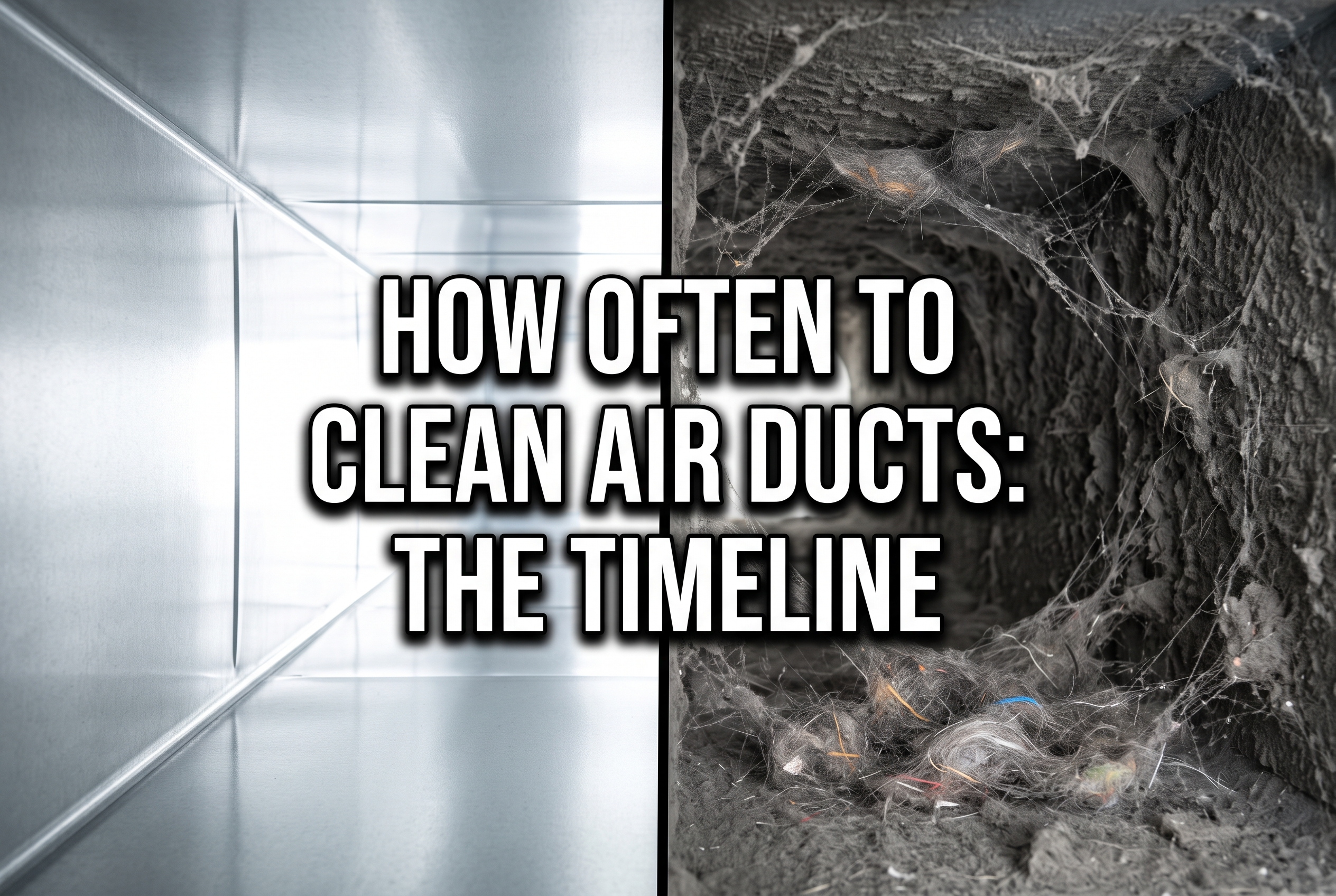
How often to clean air ducts is one of the most critical aspects of preventative home maintenance, yet it remains a massive source of confusion for property owners. Because your central HVAC system operates completely out of sight, it is incredibly easy to forget that the hidden network of metallic pipes behind your drywall is continuously acting as a massive biological filter for your home. While you diligently change your 1-inch fiberglass filter every month, that thin layer of cardboard cannot stop 100% of the microscopic debris, pet dander, and aerosolized dirt from building up inside your supply lines.
If you wait until your home constantly smells musty or your AC compressor burns out from static pressure, you have waited far too long. Proactive maintenance is the only way to protect your indoor air quality and the expensive mechanical components of your climate control system.
At The Duct Pros, we specialize in professional HVAC diagnostics and high-velocity physical HEPA extraction. We believe in honest timelines and transparent servicing. Here is a highly technical breakdown of exactly when you need to schedule professional extraction and the environmental factors that rapidly accelerate the contamination timeline.
1. The Standard 3-to-5 Year Baseline
For the average residential property, a routine schedule is highly predictable.
The Industry Standard: Under normal living conditions—a standard-sized family with excellent housekeeping and regular HVAC filter changes—you should schedule a professional commercial-grade duct cleaning every 3 to 5 years.
The Physics of Accumulation: It takes roughly 36 to 60 months for standard microscopic household dust to bypass the primary filter and build a thick enough physical layer on the interior sheet metal to begin causing aerodynamic friction (static pressure) against your blower motor.
2. Factors That Accelerate the Timeline
Not all homes operate under “normal” conditions. Several factors will drastically shorten the timeline to every 1 to 2 years.
Heavy-Shedding Pets: Dogs and cats shed millions of hairs and skin cells (dander) that carry static electricity. This fur instantly clings to the walls of your ductwork, creating a sticky biological net that traps passing dirt. Homes with multiple pets require high-velocity extraction every 2 years to prevent the AC coil from suffocating.
Indoor Allergies or Asthma: If an occupant suffers from severe respiratory issues, waiting 5 years allows too many dust mites and pollen particles to accumulate and aerosolize. Sensitive immune systems require the system to be clinically sanitized every 1 to 2 years.
3. Moving Into a New or Previously Owned Home
Never inherit a stranger’s indoor air pollution.
The Unknown History: When purchasing an existing home, you have no idea if the previous owners smoked indoors, owned multiple pets, or neglected the HVAC filter for a decade. Knowing how often to clean air ducts in this scenario is simple: you must do it immediately upon moving in.
Hitting the Reset Button: A total HEPA extraction permanently removes the biological footprint of the previous family, ensuring your new home blows genuinely fresh, sterilized air.
4. Post-Construction and Major Renovations
Home improvement projects generate industrial-level contamination.
The Drywall Dust Threat: If you have recently completed a kitchen remodel, knocked down drywall, or refinished hardwood floors, your timeline accelerates immediately. Abrasive silica dust and sawdust will aggressively bypass your filters, coating the blower motor and the wet evaporator coil in a thick, cement-like mud.
Mandatory Extraction: You must schedule a professional duct cleaning the exact week your contractors pack up their tools to prevent catastrophic damage to your HVAC equipment.
5. The Professional HEPA Assessment
True source removal requires heavy-duty industrial engineering.
Total Line Clearing: When your timeline is up, you cannot rely on consumer-grade vacuums. At The Duct Pros, we connect truck-mounted HEPA negative air machines directly to your HVAC trunk lines. We pull your entire duct network under extreme vacuum pressure, using specialized pneumatic whips to safely shatter the caked-on dust and extract it completely out of your home.
Stop guessing about the health of your home’s respiratory system. Follow the professional timeline, protect your expensive mechanical equipment, and restore your indoor air quality by scheduling a high-velocity extraction today.
📞 (866) 712-1122
🌐 www.theductpros.us
📧 Info@theductpros.us
🎯 Frequently Asked Questions About Cleaning Frequency
How often to clean air ducts: Does burning candles mean I need to clean my ducts more often? Yes. Heavily scented jar candles emit microscopic carbon soot into the air. Your return vents aggressively inhale this soot, depositing a greasy, black film on the interior walls of your ductwork and the evaporator coil. If you burn candles daily, you will need to schedule a professional extraction every 2 years to prevent this black soot from physically staining your ceiling registers and drywall.
How often to clean air ducts: How do I know if I waited too long between cleanings? Your home will display distinct physical warning signs. If you wipe down your furniture and a thick layer of dust returns within 48 hours, or if you notice a heavy, musty “dirty sock” smell every time the air conditioner turns on, the biological contamination inside your system has reached critical mass and requires immediate HEPA extraction.
How often to clean air ducts: Will upgrading my air filter change the cleaning timeline? Using a high-quality pleated filter (MERV 8 to 11) is fantastic for protecting your blower motor from massive debris, and it helps maintain the standard 3-to-5 year timeline. However, no filter catches 100% of microscopic particulate matter. Over a 5-year span, the micro-dust that bypasses the filter will still build into a heavy sludge that requires professional pneumatic extraction.