

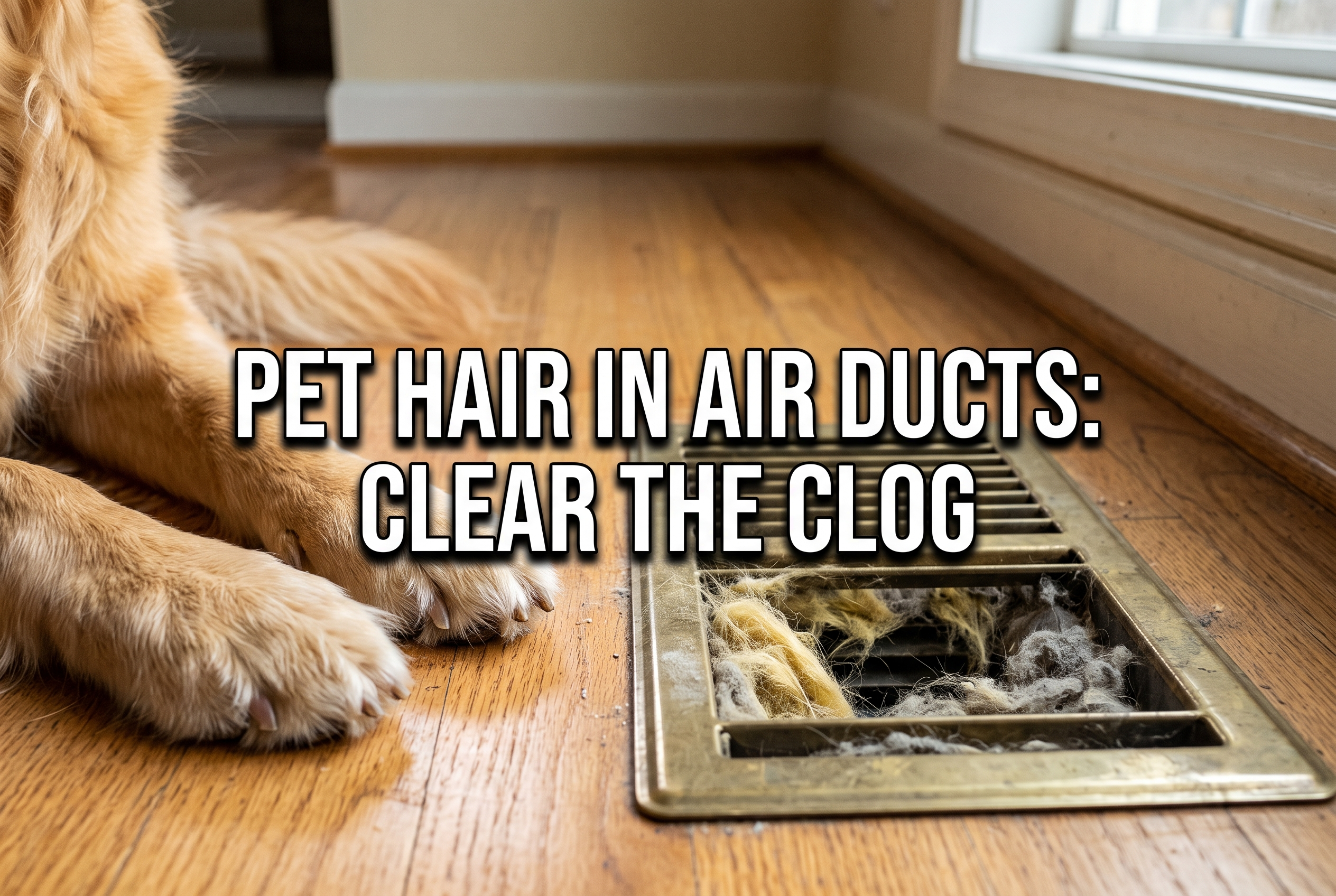
Pet hair in air ducts is a guaranteed reality for any homeowner living with dogs or cats. We love our pets, but their natural shedding cycles wage a continuous, invisible war against your home’s central heating and cooling system. While you may be diligent about vacuuming your carpets and lint-rolling your furniture, the lightweight, aerodynamic nature of pet fur means a massive percentage of it becomes airborne.
Because your HVAC return vents act as the lungs of your house, they aggressively inhale this floating fur, drawing it directly into your hidden ductwork. Once inside, pet hair does not simply blow through the system and disappear; it acts as a highly effective, sticky net that traps other airborne particulates, eventually starving your HVAC equipment of the airflow it needs to survive.
At The Duct Pros, we specialize in high-velocity physical extraction and complete airflow restoration. We do not replace broken AC compressors, but our core mission is preventing them from burning out in the first place. Here is a technical breakdown of how heavy shedding compromises your ventilation system and why professional extraction is required for pet owners.
1. The “Velcro Effect” Inside Your Pipes
Pet hair behaves differently than standard household dust when it enters a duct.
Static Cling and Oils: Animal fur carries natural skin oils and generates static electricity. When it enters a metallic or plastic-lined duct, it instantly clings to the interior walls.
The Debris Net: Once a base layer of fur sticks to the walls, it acts like Velcro for all other passing debris. Microscopic skin cells, dust mites, and pollen get caught in the fur, rapidly building up into a thick, matted blanket of organic sludge that chokes the diameter of the pipe.
2. Filter Bypass and Blower Motor Strain
Do not assume your standard 1-inch fiberglass filter is catching all the fur.
The Overflow: In a home with multiple pets, standard filters become completely blinded (clogged) with fur in a matter of weeks. When the filter is choked, the immense suction of the blower motor forces the floating hair to pull through the microscopic gaps around the filter’s cardboard frame.
Motor Suffocation: When this bypassed fur wraps around the high-speed fan blades of your blower motor, it throws the heavy metal cylinder off-balance. The motor must consume significantly more electricity to turn the fan, eventually causing the electrical components to overheat and fail.
3. Evaporator Coil Freezing
Pet hair is highly insulating, which is a disaster for your air conditioning.
Blocked Thermal Transfer: If fur bypasses the filter and coats the wet, cold fins of your AC’s indoor evaporator coil, it creates a thermal barrier. The refrigerant inside the coil can no longer absorb heat from your home’s air.
The Ice Block: Because the heat cannot transfer, the temperature of the coil drops below freezing. The condensation turns to solid ice, completely blocking all airflow and potentially destroying your outdoor compressor.
4. The Source of the “Wet Dog” Smell
If your home smells stale despite your best cleaning efforts, the ductwork is the culprit.
Bacterial Growth: The thick mats of trapped pet hair and dander sitting inside your ducts absorb ambient humidity. Over time, bacteria begin to break down the natural proteins in the fur, off-gassing the distinct, musty “wet dog” odor through every vent in your house simultaneously.
5. Professional HEPA Extraction
Household vacuums cannot remove sticky, matted fur from deep inside the walls.
Pneumatic Agitation: At The Duct Pros, we utilize industrial truck-mounted HEPA vacuums combined with high-torque pneumatic whips. These air-driven whips violently lash the interior walls of your ductwork, safely tearing the matted fur and dust away from the metal, while our massive negative pressure extracts it completely out of your home.
Protect your expensive HVAC equipment and eliminate stale animal odors. Give your home’s respiratory system a fresh start by scheduling a professional duct cleanout today.
📞 (866) 712-1122
🌐 www.theductpros.us
📧 Info@theductpros.us
🎯 Frequently Asked Questions About Pets and HVAC Systems
Pet hair in air ducts: How often should I have my ducts cleaned if I have pets? If you have multiple heavy-shedding pets (like Golden Retrievers, Huskies, or long-haired cats), you should schedule a professional HEPA air duct cleaning every 1 to 2 years. This prevents the rapid accumulation of matted fur that causes severe static pressure and mechanical strain on your blower motor.
Pet hair in air ducts: Will standard duct cleaning remove the pet smell from my house? Yes. By physically extracting the massive, hidden reservoir of decomposing hair and dander from your ductwork, you remove the primary source of the odor. For homes with extremely severe pet odors, adding an EPA-registered antimicrobial fogging treatment after the extraction will chemically neutralize any lingering bacterial smells on the metal.
Pet hair in air ducts: Can pet fur actually break my air conditioner? Absolutely. It is one of the leading causes of premature HVAC failure. When heavy fur bypasses a clogged filter, it coats the evaporator coil and suffocates the blower motor. This forces the system to run constantly without effectively cooling the home, leading to blown capacitors, frozen coils, and dead compressors.