
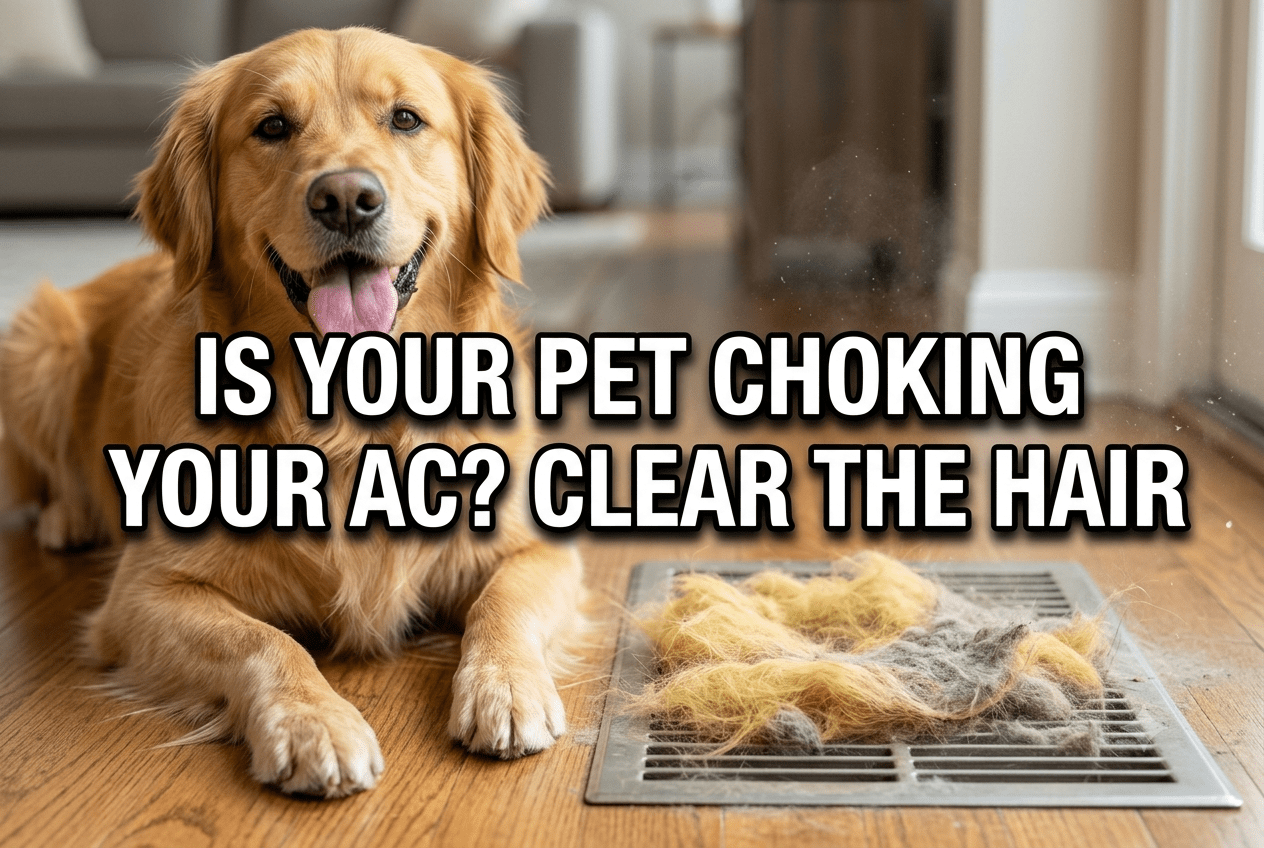
Pet hair in air vents is an unavoidable reality for millions of animal lovers. We love our dogs and cats, but the continuous shedding is a relentless battle. You likely spend hours every week vacuuming the carpets, lint-rolling the furniture, and sweeping the hardwood floors. However, the hair you can actually see is only a fraction of the problem. Your home’s central air system is constantly inhaling the ambient air, effectively acting as a giant, whole-home vacuum cleaner. Every time your pet sheds, microscopic dander and weightless fur are aggressively pulled directly into your ductwork.
While a few stray hairs might seem harmless, over several months, this biological debris fundamentally alters the physics of your ventilation system. When pet hair binds with household dust and oily dander inside the dark, metallic tubes of your HVAC system, it creates a suffocating, impenetrable blanket that destroys your energy efficiency and threatens your expensive mechanical equipment.
At The Duct Pros, we are the premier authorities in whole-home air quality restoration. While we do not handle new equipment installations, our core expertise lies in rescuing existing HVAC systems from severe biological restrictions. If you have indoor pets and find yourself constantly dusting or dealing with a struggling air conditioner, here is the technical reality of what pet hair is doing to your ductwork and why professional extraction is a mandatory part of pet ownership.
1. The “Hair Mat” Effect in Return Air Vents
Your HVAC system operates on a precise circulatory loop. To push cold air out, it must pull warm air in through the large return grilles.
The First Point of Failure: Because return grilles pull massive volumes of air, they act like magnets for floating pet hair. As the hair is sucked against the metal louvers and the internal filter, it rapidly weaves itself into a dense, felt-like mat.
Static Pressure Drop: This mat of hair creates an immediate, severe restriction in volumetric airflow. The blower motor is suddenly starved for oxygen, causing the static pressure to plummet. The motor will draw excessive electrical current trying to pull air through the blockage, resulting in a skyrocketing utility bill and premature mechanical wear.
2. The Oily Nature of Pet Dander
The hair itself is only half the threat; the real danger lies in the microscopic dander attached to it.
Sticky Proteins: Unlike dry household dust, dog and cat dander is highly oily. It is composed of skin flakes coated in the animal’s natural sebaceous oils and saliva proteins.
The Accumulation Cycle: When this oily dander is pulled deep into the supply lines, it easily bypasses standard fiberglass filters. It strikes the interior metal walls of the ductwork and acts like an industrial adhesive. This sticky layer catches every subsequent piece of dust, pollen, and fur passing through, rapidly building a thick, restrictive interior coating that slows down airflow to a crawl.
3. The Threat to the Evaporator Coil
If you rely on cheap, 30-day fiberglass filters, your pets are inadvertently plotting to destroy your air conditioner.
Bypassing the Filter: Fine cat hair and microscopic dander easily slip past low-MERV filters and head directly into the air handler. The first thing this debris hits is the indoor evaporator coil—a matrix of tightly packed, freezing-cold aluminum fins covered in condensation.
The Mud Block: The pet fur and dust stick to the wet coil, creating a thick, muddy paste. This physically blocks the air from passing through the fins. Without airflow, the coil’s temperature drops drastically until it freezes into a solid block of ice, shutting down your entire system and risking a blown compressor.
4. The “Wet Dog” Scent Recirculation
If your house smells like a kennel no matter how many candles you burn, your HVAC system is the culprit.
Trapped Odors: The thick layers of hair and dander trapped in your ductwork absorb humidity from the air. Over time, this decaying biological matter ferments inside the dark piping.
Forced Distribution: Every single time the thermostat triggers the blower motor, the system violently pushes air across miles of this smelly, damp pet hair, blasting a concentrated “wet dog” or litter box odor directly into your living room, kitchen, and bedrooms.
5. High-Velocity Source Extraction
Vacuuming your vent covers with a household attachment will not solve the underlying mechanical restriction. The entire length of the ductwork must be aggressively scoured.
Pneumatic Agitation: At The Duct Pros, our commercial-grade extraction process relies on specialized pneumatic whips and high-torque brushes. We feed these lines deep into the ductwork to physically shatter the oily, sticky bond of the pet dander and rip the compacted hair mats off the metal walls.
Negative Pressure Removal: While we agitate the debris, our truck-mounted HEPA vacuum places the entire home’s ventilation system under intense negative pressure. This ensures that massive volumes of extracted pet hair, dust mites, and dander are safely pulled outside to our containment unit, never once entering your breathing space.
Do not let your pets compromise your home’s air quality or the lifespan of your HVAC equipment. Maximize your airflow, eliminate lingering pet odors, and protect your system by scheduling a comprehensive, whole-home duct cleanout today.
 (866) 712-1122
  www.TheDuctPros.us
  Info@TheDuctPros.com

 Frequently Asked Questions About HVAC Pet Hair Removal
How often should I clean my air ducts if I have pets? While a standard home might only require professional duct cleaning every 3 to 5 years, homes with multiple indoor pets (especially heavy-shedding breeds like Golden Retrievers or Huskies) should schedule a professional extraction every 18 to 24 months. The biological load of hair and dander builds up exponentially faster in a pet-friendly environment.
Will cleaning my air ducts remove pet odors? Yes. Persistent pet odors in a home are often caused by the HVAC system endlessly recirculating air over pounds of trapped hair and oily dander hiding inside the ductwork. By physically removing this biological source material and sanitizing the bare metal, we permanently eliminate the hidden reservoir of odors.
Can pet hair break my air conditioner? Absolutely. If pet hair and dander bypass your air filter, they will impact directly against the wet evaporator coil. This creates a thick layer of biological “mud” that suffocates the system, causing the coil to freeze solid. Furthermore, clogged return vents force the blower motor to work twice as hard, leading to overheating and premature electrical failure.