

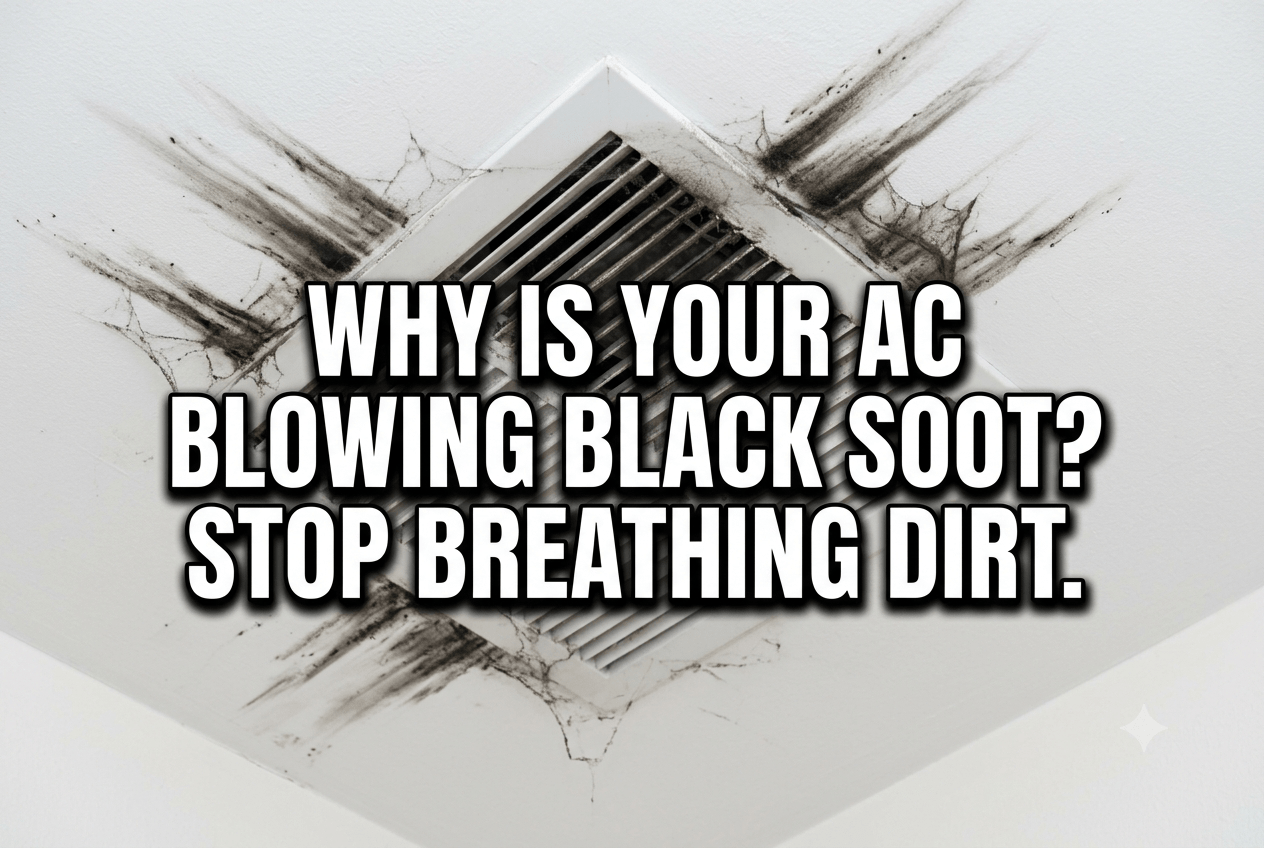
Black dust from air vents is one of the most alarming discoveries a homeowner can make. You spend hours meticulously cleaning your home, only to look up and realize that dark, greasy-looking dirt is rapidly spreading across your white ceilings and ruining the paint around your registers. Not only is this an aesthetic nightmare, but it is also a glaring physical warning sign that your central heating and cooling system is distributing a highly concentrated respiratory irritant into your breathing space.
Many homeowners incorrectly assume that this dark residue is just normal household dust that has been trapped for too long. Standard household dust, composed mostly of human skin cells and fabric fibers, is light gray and fluffy. If the particulate matter blowing out of your ventilation system is pitch black, smears like grease when you try to wipe it, or forms dark webs on the ceiling, you are dealing with a much more complex and dangerous indoor air quality failure.
At The Duct Pros, we are Your Trusted Experts In Fresh Air, and we routinely diagnose and eradicate severe airborne particulate issues. If you are tired of scrubbing black stains off your walls and worrying about what your family is inhaling, here is a highly technical breakdown of why your system is blowing black soot, the hidden mechanical and lifestyle causes, and how professional extraction permanently resolves the threat.
1. The Most Common Culprit: Candle Soot and Combustibles
In the vast majority of cases, the black dust staining your ceilings is not actually dust at all; it is microscopic carbon soot caused by indoor combustion.
Petroleum-Based Candles: The biggest offenders are heavily scented, mass-produced jar candles. Many of these candles are made with paraffin wax—a petroleum byproduct. When burned, they release microscopic, highly sticky carbon soot particles into the air.
The HVAC Vacuum Effect: Your HVAC system’s return vent acts as a massive vacuum. While a candle is burning in your living room, the return vent aggressively inhales the invisible soot. Because soot particles are so incredibly small, they easily bypass standard fiberglass furnace filters and coat the interior walls of your ductwork with a thick, greasy black film. When the forced air blows back into the house, it rips this soot off the walls and blasts it into your bedrooms.
2. Deteriorating HVAC Insulation and Blower Components
If you do not burn candles or use a wood-burning fireplace, the black dust may actually be pieces of your HVAC system rapidly breaking apart and blowing into your home.
Decaying Acoustic Lining: Many older air handlers and primary return trunks are lined with a thick, black fiberglass acoustic insulation designed to dampen the sound of the blower motor. Over a decade of exposure to high-velocity airflow, temperature fluctuations, and moisture, the adhesive holding this insulation together breaks down.
Aerosolized Fiberglass: As the black acoustic liner degrades, the massive force of the blower motor rips microscopic, black fiberglass shards off the walls. This incredibly dangerous material is then shot directly out of your vents. If the black dust on your ceiling feels slightly gritty or looks like tiny black fibers, your internal insulation is failing and must be addressed immediately to prevent severe lung irritation.
3. The Threat of Black Mold and Biological Growth
If the black residue surrounding your vents looks splotchy, fuzzy, or is accompanied by a foul, musty odor, you are likely dealing with an active biological infestation.
Condensation and Dust: In humid climates, or if your ductwork is poorly insulated in the attic, condensation frequently forms on the cold metal around your supply vents. When standard household dust sticks to this condensation, it creates a perfect, damp breeding ground for toxic black mold.
Aerosolized Spores: As the mold colony matures inside the ductwork, it dries out during the heating season and begins to flake off. The heavy airflow tears chunks of the black fungal colony away from the metal pipes, blowing dark, concentrated clumps of biological waste into your living space. The Environmental Protection Agency (EPA) warns that inhaling these spores can cause severe respiratory distress and allergic reactions.
4. “Ghosting” and Thermal Tracking Mechanics
Why does the black dust stick so aggressively to the ceiling instead of just falling to the floor? The answer lies in thermodynamics and static electricity.
Thermal Tracking: This phenomenon, often called “ghosting,” occurs when cold air blowing out of your vent hits the warmer air in your room, creating microscopic condensation on the ceiling drywall.
The Static Magnet: Black soot and mold spores carry a slight static electrical charge. When these dark particles are blown across the damp, cold spots on your ceiling, they are instantly magnetically attracted to the drywall. Attempting to wipe them away with a wet rag will only smear the greasy soot deeper into the porous paint, creating a permanent stain.
5. Professional Extraction: Breaking the Contamination Cycle
You cannot fix a soot or mold-contaminated HVAC system by simply changing the filter or painting over the stains on your ceiling. The entire duct network is compromised.
Heavy-Duty Source Removal: At The Duct Pros, we do not rely on weak shop vacuums. We connect your entire ventilation infrastructure to an industrial, truck-mounted negative air machine. This places your home under extreme suction, ensuring no soot or mold spores escape into your living areas during the cleaning process.
Scouring the Metal: We utilize specialized pneumatic whips to physically agitate the interior of the ductwork, breaking the greasy, static bond of the black soot and impacted dirt. The debris is violently extracted directly to our containment units outside your home. We then sanitize the system with an EPA-registered antimicrobial fog to neutralize any remaining biological threats, leaving your air path completely sterile.
Stop painting over the problem and start addressing the root cause. Protect your family’s respiratory health and preserve the cleanliness of your home by scheduling a professional ductwork reset today.
📞 (866) 712-1122 🌐 www.TheDuctPros.us 📧 Info@TheDuctPros.us
🎯 Frequently Asked Questions About Black HVAC Dust
Why is my air conditioner blowing out black flakes? If your vents are blowing out physical black flakes rather than fine dust, it is usually a sign that the black acoustic insulation inside your air handler is deteriorating, or a heavy layer of black mold has dried up and is actively flaking off the interior walls of your ductwork. Both scenarios require immediate professional extraction, as inhaling fiberglass or massive mold colonies is highly dangerous.
Can burning candles really cause black dust around my air vents? Yes. Petroleum-based paraffin candles, especially heavily scented jar candles, produce a massive amount of microscopic carbon soot. Your HVAC return vent pulls this invisible soot into the system, where it bypasses the filter, coats the ductwork, and is blown back out, magnetically clinging to your ceilings and walls through a process called “ghosting.”
How do I clean the black dust off my ceiling? Do not use water or a wet rag, as this will smear the carbon soot deeper into the porous drywall and ruin the paint completely. First, use a dry chemical sponge (soot sponge) to gently lift the particles off the surface. However, until you have the ductwork professionally cleaned and the source of the soot extracted, the black stains will return within a few weeks.