
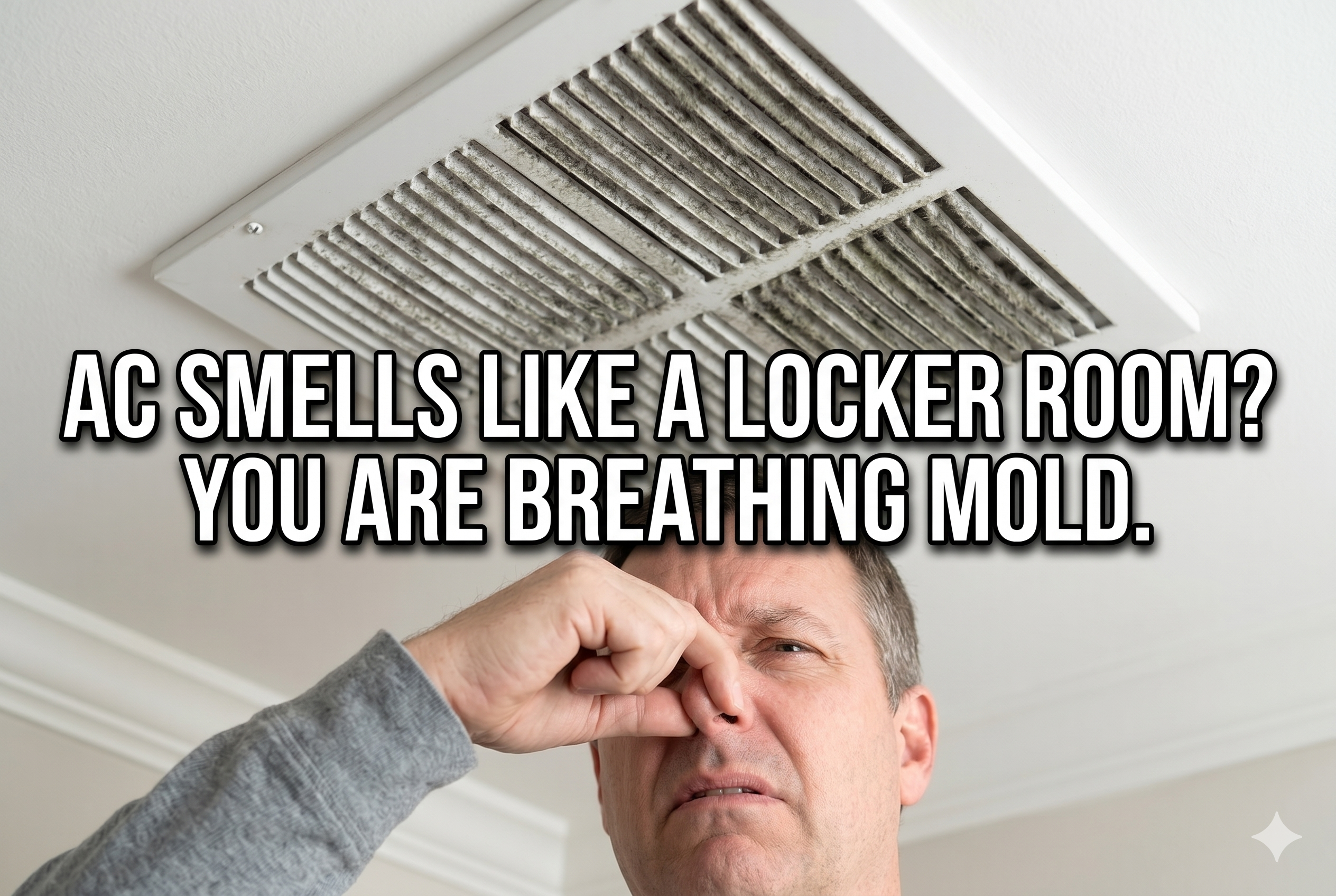
Air conditioner smells like mildew are not a symptom you can afford to ignore, mask with air fresheners, or wait out until the end of the season. Your central cooling system is designed to circulate crisp, clean, and comfortable air throughout your home. When that air suddenly carries the heavy, rotting, musty odor of a damp basement or a wet locker room, it is a definitive physical warning sign that your HVAC system has been compromised by active biological growth.
Many homeowners mistakenly believe that a foul-smelling AC is just a sign of an old filter or trapped outdoor odors. The reality is far more concerning. A musty odor blowing from your vents means that a living fungal organism—typically mold or mildew—has established a massive colony directly inside your home’s central nervous system. Because your HVAC system completely recirculates the air in your home dozens of times a day, it is effectively acting as a high-speed distribution network for biological off-gassing and toxic spores.
At The Duct Pros, we are Your Trusted Experts In Fresh Air. We routinely rescue homes from severe biological contamination, and we know exactly where these odors originate. If you are tired of holding your breath every time your thermostat kicks on, here is a deeply technical breakdown of why your system smells like rotting gym socks, the hidden mechanics driving the fungal growth, and how professional extraction permanently resolves the issue.
1. The Biological Source of the “Dirty Sock” Odor
To eliminate the smell, you first have to understand exactly what you are inhaling. The musty scent is not just “stale air”—it is a chemical byproduct of a living organism.
Volatile Organic Compounds (VOCs): When mold and mildew grow, they consume organic matter (like dead skin cells and pet dander trapped in your ductwork). As they feed, digest, and reproduce, they release gases known as Microbial Volatile Organic Compounds (MVOCs).
The Locker Room Effect: These MVOCs are entirely responsible for the signature “dirty sock” or mildew smell. Because this biological off-gassing is happening inside the sealed, highly pressurized environment of your ductwork, the blower motor forces these concentrated gases directly into your living room, bedrooms, and kitchen at high velocity. If you smell mildew, you are actively inhaling fungal waste gases.
2. Your Evaporator Coil: The Dark, Damp Breeding Ground
While mold can grow anywhere in your ductwork, the absolute most common origin point for mildew odors is the indoor evaporator coil located inside your main air handler.
The Condensation Engine: Your air conditioner cools your home by extracting heat and humidity from the indoor air. As warm air passes over the freezing cold copper tubes of the evaporator coil, massive amounts of condensation form. On a hot summer day, your AC unit can pull gallons of water out of the air.
The Perfect Fungal Storm: The inside of your air handler is pitch black. When you combine that absolute darkness with the extreme moisture of the sweating evaporator coil and the inevitable dust that bypasses your primary filter, you create a perfect, highly insulated greenhouse. Mildew aggressively colonizes the delicate aluminum fins of the coil, restricting airflow and contaminating every cubic foot of air that passes through it.
3. The Danger of Clogged Condensate Drain Lines
The moisture generated by your AC unit has to go somewhere. When the drainage system fails, biological disasters follow.
Stagnant Water Pools: The water dripping off your evaporator coil falls into a shallow metal or plastic drain pan and is routed outside through a small PVC pipe. However, if dirt, dust, and biological slime clog that narrow drain line, the water backs up.
The Swamp Effect: A clogged drain pan turns the interior of your HVAC unit into a stagnant indoor swamp. This standing water rapidly breeds highly toxic strains of black mold and heavy mildew. Every time the system turns on, the air sweeps violently across this rotting pool of water, instantly filling your entire home with a heavy, sickeningly sweet, or musty odor.
4. Why Masking the Smell is a Dangerous Mistake
When faced with a smelly AC, the average homeowner immediately buys scented candles, aerosol sprays, or essential oil diffusers to mask the odor. This is a massive mistake.
Ignoring the Root Cause: Scented sprays do absolutely nothing to kill the physical mold colony growing on your coil or in your ductwork. You are simply layering artificial chemical fragrances over active biological off-gassing.
Accelerating Health Risks: While you mask the smell, the mold colony continues to grow thicker and more robust. It will eventually begin releasing millions of microscopic, reproductive spores into your air supply. According to the Environmental Protection Agency (EPA), inhaling these aerosolized spores can trigger severe allergic reactions, chronic asthma attacks, sinus infections, and profound fatigue.
5. The Professional Sterilization and Antimicrobial Process
You cannot fix a biologically contaminated HVAC system with a bottle of household bleach and a rag. Bleach is mostly water and will only feed the root structure of the mold inside your porous ductwork.
Deep Coil Cleaning and Extraction: Eradicating the odor requires complete physical extraction. We utilize heavy-duty, truck-mounted negative air machines to place your ductwork under intense suction, guaranteeing no spores escape into your home. We physically scrub the interior lines and apply specialized, non-corrosive foaming degreasers to the evaporator coil to melt away the biological slime and impacted dirt.
EPA-Registered Antimicrobial Fogging: Once the physical debris is violently extracted from your home, we finalize the sterilization process. We introduce a hospital-grade, EPA-registered antimicrobial fog directly into the airflow. This fine mist penetrates every microscopic crevice of the ductwork and the air handler, killing the invisible fungal roots and instantly neutralizing the MVOCs causing the mildew smell.
📞 (866) 712-1122 🌐 www.TheDuctPros.us 📧 Info@TheDuctPros.us
🎯 Frequently Asked Questions About Smelly AC Units
Why does my air conditioner smell like mildew when I turn it on? If your AC smells like mildew, it means mold or bacterial slime is actively growing inside the unit. This usually happens on the indoor evaporator coil or in the condensate drain pan. The dark, extremely damp environment inside the air handler is the perfect breeding ground for fungus. As the mold feeds on trapped dust, it releases volatile gases that are blown directly into your home.
Can a mildew-smelling air conditioner make me sick? Yes. The smell itself is caused by fungal off-gassing (MVOCs), which indicates the presence of an active biological colony. As the mold grows, it releases microscopic spores into your breathing space. Inhaling these spores continuously can trigger severe coughing, sneezing, watery eyes, sinus pressure headaches, and dangerous asthma flare-ups.
Will changing the air filter fix an AC that smells like mildew? No. While changing a dirty filter is crucial for airflow, the primary air filter is located before the evaporator coil and the ductwork. If you are smelling mildew, the biological growth has already bypassed the filter and colonized the internal mechanical components or the metal supply lines. The only way to stop the odor is through professional physical extraction and antimicrobial sterilization.