

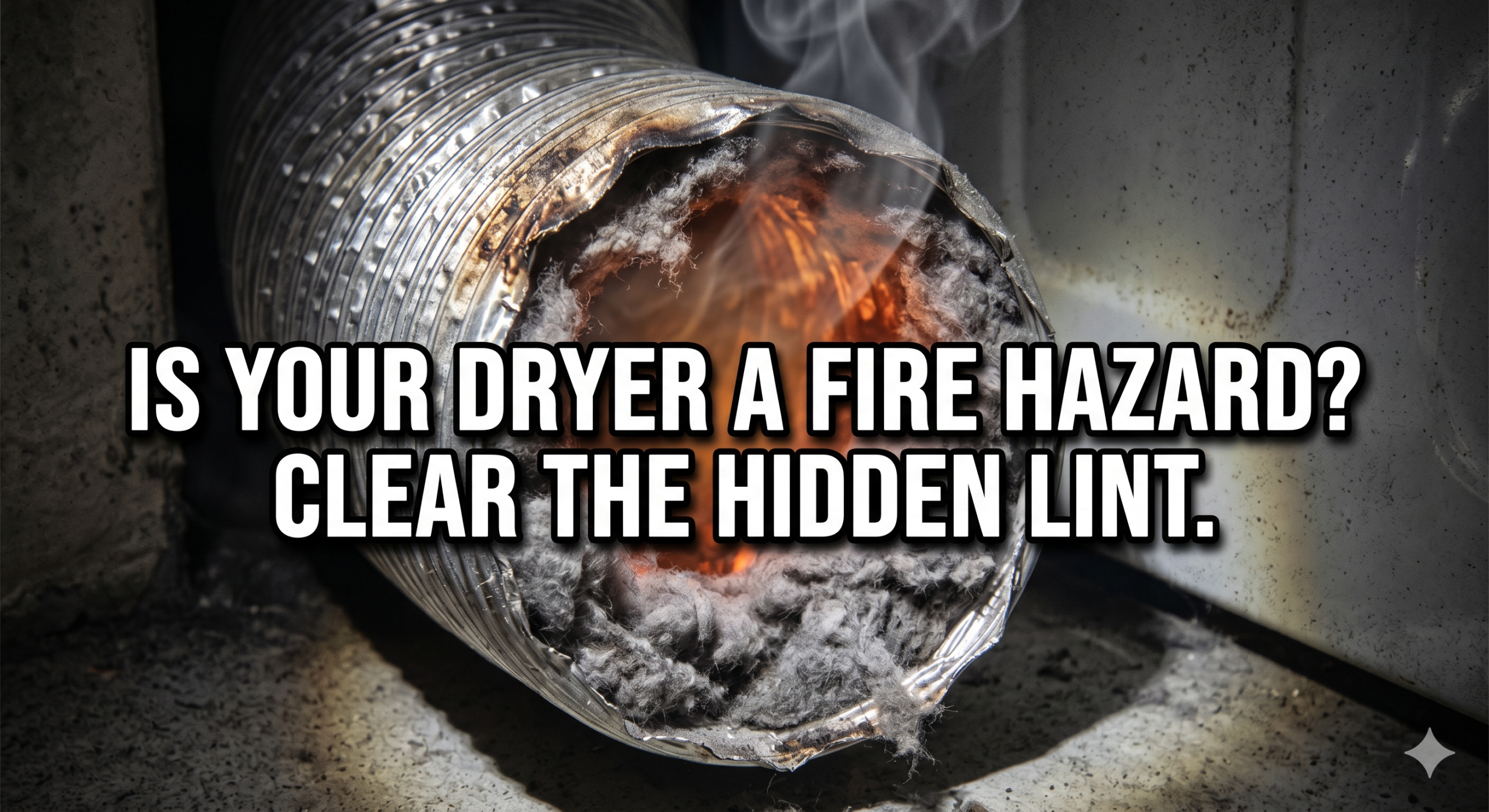
Dryer vent cleaning for fire safety is one of the most critically overlooked home maintenance tasks, yet it is arguably the most important for protecting your property and your family’s lives. When most homeowners think of potential fire hazards, they focus on leaving the stove unattended, faulty electrical wiring, or forgetting to blow out a candle. Very few people look at the innocuous white appliance sitting quietly in their laundry room. However, according to the U.S. Fire Administration, clothes dryers are responsible for nearly 3,000 residential fires every single year, resulting in millions of dollars in property damage, severe injuries, and tragic fatalities.
The leading cause of these catastrophic appliance fires is surprisingly simple: a failure to clean the exhaust venting system. Over time, highly combustible lint bypasses your machine’s primary filter and heavily clogs the exhaust pipe, creating a dangerous combination of extreme heat, restricted airflow, and perfect kindling. At The Duct Pros, we specialize in the complete extraction of these severe blockages. If you have never had your dryer’s exhaust line professionally cleared, here is a comprehensive, technical breakdown of exactly how a dryer fire starts, the warning signs your home is at risk, and why professional extraction is a non-negotiable safety requirement.
1. The Anatomy of a Dryer Fire: How Lint Ignites
To understand the severe risk, you have to understand the mechanics of how your clothes dryer operates and the inherent flammability of the byproduct it produces.
The Perfect Kindling: Dryer lint is primarily composed of tiny fibers from cotton clothing, synthetic fabrics, pet hair, and dust. Because these fibers are microscopically thin and completely dried out by the machine’s heat, lint is incredibly combustible. In fact, survivalists actively use dryer lint as a premier fire starter for camping because it ignites instantly from a single spark.
The Exhaust Bypass: You might clean the small lint trap screen inside the dryer door after every load, but that screen only catches about 75% to 80% of the debris. The remaining 20% to 25% of the lint is forcefully blown directly into the exhaust vent pipe located behind the machine.
The Ignition Point: As lint builds up inside the walls of the exhaust pipe, it drastically restricts the airflow. The dryer relies on that airflow to push the intense heat out of the house. When the heat cannot escape, it backs up into the dryer cabinet. The internal temperature continues to rise until it eventually reaches the flashpoint of the trapped lint, causing the blockage to burst into flames directly inside your drywall.
2. Critical Warning Signs Your Dryer Vent is Severely Clogged
Your dryer will typically give you several mechanical warnings that the exhaust line is choked before a fire actually starts. Recognizing these symptoms can save your home.
Multiple Cycles to Dry One Load: This is the most common and ignored warning sign. If a standard load of towels or heavy jeans takes two or three full 60-minute cycles to dry completely, your vent is severely clogged. The damp air cannot physically escape the drum, so your clothes simply tumble in a hot, humid sauna.
Excessive Heat in the Laundry Room: When a dryer is operating properly, the exterior cabinet of the machine should be slightly warm, and the laundry room should remain at a normal, comfortable temperature. If the top of the dryer is painfully hot to the touch, or if the laundry room feels like a tropical greenhouse, the exhaust heat is backing up.
A Burning Odor During Operation: If you ever notice a faint, acrid, or burning smell while the dryer is running, stop the machine immediately. This means the lint inside the exhaust line or the dryer cabinet is getting dangerously close to its ignition temperature.
The Exterior Flap Remains Closed: Go outside to where the dryer vents completely exit your house. When the dryer is running, the louvers or the flap on that exterior cover should be blown wide open by the force of the exhaust. If the flap barely opens, or remains completely shut, there is a massive blockage inside the wall preventing the air from escaping.
3. The Hidden Financial Drain of a Clogged Vent
Beyond the catastrophic risk of a fire, a clogged dryer vent acts as a massive, silent drain on your monthly finances and dramatically reduces the lifespan of your expensive appliance.
Skyrocketing Electric or Gas Bills: A dryer is typically one of the most energy-intensive appliances in a modern home. When you are forced to run the machine for two or three hours just to dry a single load of laundry, you are doubling or tripling the energy consumption for that chore.
Premature Appliance Failure: Modern dryers are designed with thermal fuses and delicate heating elements. When a clogged vent forces the internal temperature to spike, it causes severe, accelerated wear and tear on the blower motor, snaps the drive belts, and permanently burns out the heating element. Homeowners frequently spend thousands of dollars replacing a “broken” dryer, only to realize the new machine won’t dry clothes either because the actual problem was the clogged pipe hidden in the wall.
4. Why DIY Hardware Store Cleaning Kits Fall Short
Many homeowners attempt to solve a slow-drying issue by purchasing a cheap, 10-foot brush attachment from a local hardware store and attaching it to their cordless drill. This approach frequently makes the situation much more dangerous.
Compacting the Blockage: The exhaust lines in many modern homes run 20 to 30 feet through the ceiling or up to the roof, incorporating multiple sharp, 90-degree elbows. A flimsy DIY brush cannot safely navigate these turns. Instead of extracting the lint, homeowners end up pushing the debris deeper into the pipe, compacting it into a solid, impenetrable plug at an elbow joint.
Tearing the Flex Duct: Many homes utilize thin, flexible foil ductwork for portions of the exhaust line. Aggressive, uncalibrated DIY brushing can easily tear massive holes in this delicate foil. Once the duct is torn, the dryer will violently pump highly flammable lint and hot, humid exhaust directly into your wall cavities or attic, creating massive mold issues and an extreme hidden fire hazard.
5. The Professional Extraction and Airflow Restoration Process
Ensuring your home is genuinely safe requires commercial-grade extraction equipment and professional techniques.
High-Powered HEPA Extraction: At The Duct Pros, we do not rely on standard household vacuums. We utilize powerful, truck-mounted or portable 500 CFM true HEPA vacuum systems. We place the entire exhaust line under heavy negative pressure to ensure no lint escapes into your laundry room.
Rotary Agitation and Anemometer Testing: While the system is under intense vacuum pressure, we feed flexible, pneumatic rotary brushes through the entire length of the pipe—from the back of the dryer all the way to the exterior roof or wall cap. This aggressively scrubs the caked-on lint from the pipe walls and safely pulls the heavy blockages out. Finally, we use an anemometer to physically measure the restored airflow velocity, guaranteeing the line is completely clear, safe, and operating at peak factory efficiency.
Do not wait for a burning smell or an abnormally hot appliance to force you into action. Protect your home, dramatically reduce your utility bills, and cut your laundry time in half by prioritizing your ventilation maintenance today.
📞 +1 (866) 712-1122
🌐 www.TheDuctPros.us
📧 Info@TheDuctPros.us
🎯 Frequently Asked Questions About Dryer Vents (People Also Ask)
How often should you have your dryer vent cleaned?
Fire safety experts and appliance manufacturers strongly recommend scheduling a professional dryer vent cleaning at least once every 12 months. However, if you have a large family, do multiple loads of laundry a day, or have pets that shed heavily, you should have the exhaust line inspected and cleared every 6 to 8 months to prevent dangerous lint compaction.
What happens if you never clean your dryer vent?
If you neglect to clean the exhaust line, the highly flammable lint bypasses the filter and heavily restricts the airflow. This causes the dryer to run extremely hot and take hours to dry a single load of clothes. Eventually, the trapped heat will reach the ignition point of the compacted lint, sparking a severe, rapidly spreading fire inside the walls of your home.
How do professionals clean a dryer vent?
Professionals utilize a combination of heavy negative pressure vacuums and specialized rotary brush systems. They detach the transition hose from the back of the dryer and insert flexible, motorized brushes that can safely navigate 90-degree turns and extend all the way to the roof or wall exit. This physically breaks up the solid lint blockages, which are then violently extracted by the high-powered vacuum, completely restoring the safe exhaust flow.